
What is NRR? In short, NRR (net revenue retention) measures how much recurring revenue a business keeps and grows from its existing customers over a set period, without counting any revenue from new customer wins. For agencies, consultancies, and other retainer-based businesses, this single number often says more about long-term health than new sales ever could. Therefore, understanding it is one of the fastest ways to see whether a service business is actually growing or just replacing lost clients.
Quick answer: NRR is the percentage of recurring revenue retained from existing customers, including expansions and downgrades but excluding new customer revenue. A rate above 100% means existing clients are generating more revenue than before, even after accounting for churn.

A visual sense of what is NRR: a dashboard tracking growth from existing accounts over time.
What Is NRR? A Clear Definition
NRR, or net revenue retention, answers one specific question: did our existing customers generate more or less revenue this period compared to last? Specifically, it starts with the recurring revenue from a defined group of customers, then adds any expansion revenue (upsells, upgrades, added scope) and subtracts contraction and churned revenue from that same group. Unlike a simple customer count, NRR is dollar-weighted. Consequently, losing one small client matters far less than losing a large one, which gives leadership a far more accurate read on financial health.
This metric originated in SaaS (software-as-a-service) reporting, where it became a key signal for investors. However, service businesses that run on retainers, memberships, or subscriptions rely on the same underlying economics. As a result, NRR has become just as relevant for marketing agencies, fractional executive firms, and coaching businesses as it is for software companies.
Why Net Revenue Retention Matters for Service Businesses
For agencies and consultancies, new sales get most of the attention, yet existing clients usually fund most of the business. In fact, it is often far cheaper to grow an existing account than to win a new one from scratch. Because of this, net revenue retention is frequently described as a growth lever hiding in plain sight.
When NRR is strong, a business can grow even in a slow sales quarter. In contrast, weak NRR quietly erodes growth, forcing teams to replace lost revenue just to stand still. According to industry benchmark research from SaaS metrics firms, median net revenue retention across subscription businesses typically sits near 100% to 105%, while top-performing companies regularly report 120% or higher. That gap illustrates exactly why tracking this number consistently is worth the effort.
You can read more on how retention compounds into revenue in this guide on revenue retention and how to keep more of your revenue.
The NRR Formula (And How to Calculate It)
The standard formula looks like this:
In practice, calculating this number accurately requires a consistent, repeatable process. Here is how to do it step by step:
- Gather the starting recurring revenue from the exact group of customers active at the beginning of the period, before any new sales are added.
- Add expansion revenue gained from that same group through upsells, upgrades, added seats, or expanded service scope.
- Subtract contraction revenue from clients who downgraded or reduced scope while remaining active customers.
- Subtract churned revenue from clients in that original group who canceled entirely during the period.
- Divide the result by the starting revenue figure, then multiply by 100 to get your net revenue retention percentage.
Notably, new customer revenue never enters this calculation. That exclusion is what makes NRR such a clean measure of how well a business retains and grows the customers it already has, as described in general terms on Wikipedia's overview of revenue.
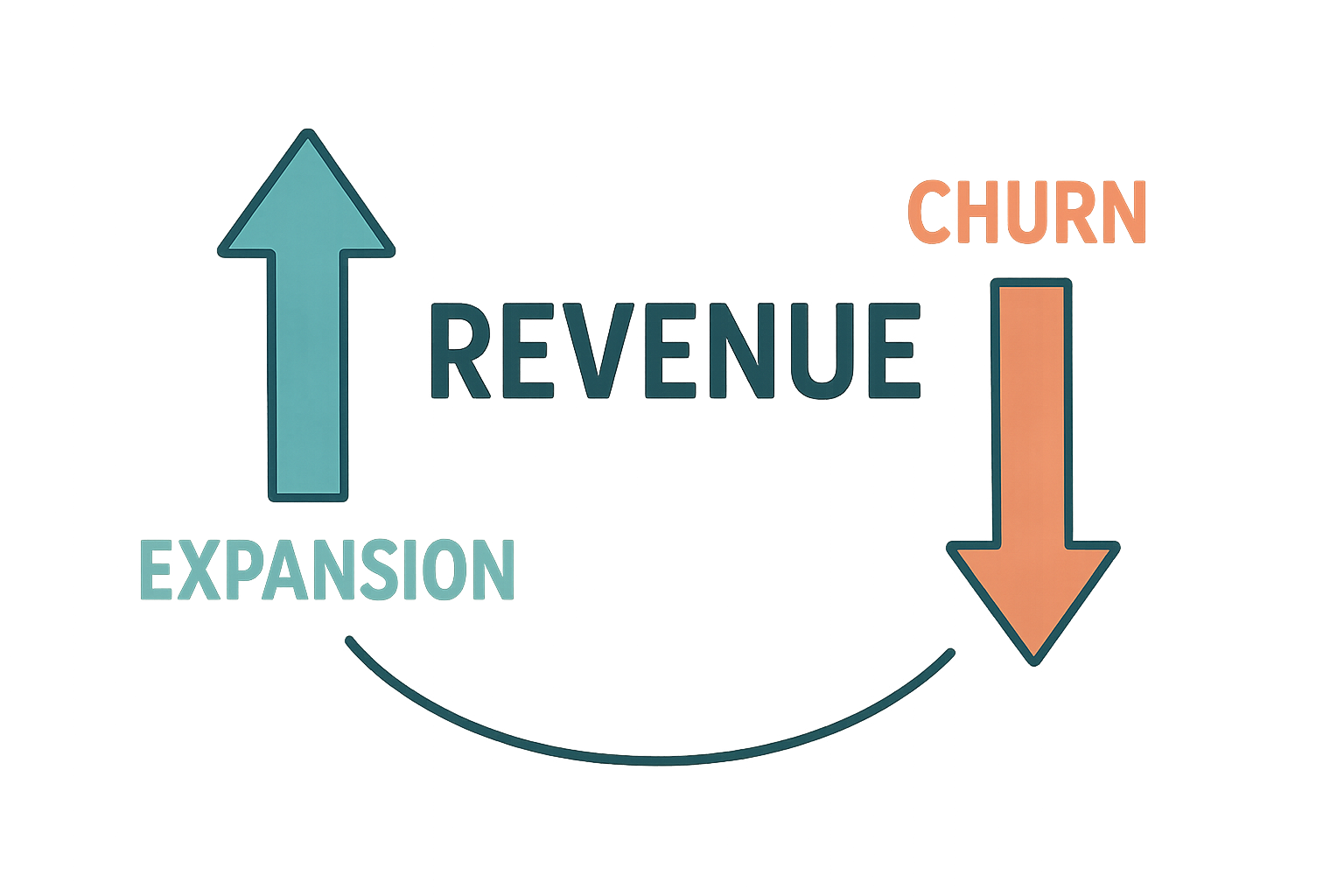
The components that make up the NRR formula: expansion, contraction, and churn.
NRR vs. GRR: What's the Difference?
GRR, or gross revenue retention, is NRR's more conservative sibling. It subtracts contraction and churn, but it never adds expansion revenue back in. Therefore, GRR always caps at 100%, since it only measures what was kept, not what was grown.
NRR, on the other hand, can exceed 100% because it rewards upsells and account growth. In other words, GRR tells you how much revenue you protected, while NRR tells you whether existing clients are actually expanding. For a deeper look at related loss metrics, see this breakdown of churn rate meaning, formula, and how to fix it.
What Is a Good NRR Benchmark?
Generally speaking, an NRR between 100% and 110% is considered healthy for most recurring-revenue businesses. Meanwhile, best-in-class companies often push past 120%, largely through disciplined account management and proactive expansion efforts. Conversely, an NRR below 90% usually signals that churn or downgrades are outpacing growth, which deserves immediate attention. For a broader view of related loss trends, this churn rate business guide covers how to track and cut customer loss.
How to Improve Your Net Dollar Retention
Net dollar retention, often used interchangeably with NRR, improves when businesses get ahead of problems rather than reacting to them. Specifically, three levers tend to move this number the most: reducing churn, limiting downgrades, and actively surfacing expansion opportunities.
First, early warning systems matter enormously. For example, tracking engagement, response times, and sentiment across every active account makes it possible to flag at-risk relationships before a cancellation notice arrives. This guide on spotting at-risk clients before they cancel walks through exactly how that process works in practice.
Second, structured onboarding reduces early churn significantly, since clients who see value in their first 30 days rarely leave soon after. Third, regular pulse checks and quarterly business reviews create natural moments to propose upsells, which directly lifts expansion revenue. Together, these three habits are what separate businesses with strong NRR from those constantly fighting to replace lost accounts.
Common Mistakes When Tracking NRR
Even experienced finance and operations teams stumble on a few recurring issues. For instance, mixing new customer revenue into the calculation inflates the number and hides a real retention problem. Similarly, using inconsistent time periods from month to month makes trend analysis unreliable.
Another frequent error is treating one-time fees, such as setup or project work, as recurring revenue. This distorts both the starting and ending figures. Finally, some teams calculate NRR once a quarter but never review it at the account level, missing the early signals that a daily or weekly client health score would catch. A broader look at retention software options is available in this 2026 guide to renewal and retention management software.

Daily visibility into client health helps teams catch problems before they hit NRR.
How ClientBloom Helps Service Businesses Improve NRR
ClientBloom is built specifically for agencies, consultancies, and other retainer-based service businesses where retention drives recurring revenue. Rather than replacing a CRM, it connects to the tools a team already uses and scores the health of every client relationship continuously with its Client Retention Score. As a result, teams receive a morning brief in Slack, email, text, or Telegram that flags exactly which accounts need attention and why.
Because expansion and churn both flow through the same client data, the platform's analytics dashboard surfaces renewal and upsell opportunities alongside churn forecasts, which directly supports a healthier NRR over time. You can learn more about the full setup at clientbloom.ai.
Frequently Asked Questions About NRR
What is NRR?
NRR, or net revenue retention, is the percentage of recurring revenue a business keeps from its existing customers over a period, including expansion and contraction but excluding new customer sales.
How do you calculate NRR?
Take starting recurring revenue, add expansion revenue, subtract contraction and churned revenue, then divide by the starting revenue and multiply by 100.
What is a good NRR benchmark?
Most healthy recurring-revenue businesses aim for 100% to 110% NRR, while top performers often exceed 120%. Anything below 90% usually signals a retention problem.
What's the difference between NRR and GRR?
GRR only counts downgrades and churn, so it caps at 100%. NRR adds expansion revenue back in, so it can exceed 100%.
How is NRR different from churn rate?
Churn rate counts lost customers or lost revenue, while NRR nets churn against expansion revenue to show overall account growth or decline.
Why does NRR matter for agencies and service businesses?
Retainer-based businesses rely on recurring revenue, so NRR shows whether existing clients are growing, shrinking, or canceling faster than new sales can replace them.
How often should a business track NRR?
Most service businesses review NRR monthly and report it quarterly, since short-term swings can hide real trends in client health.
Can NRR go above 100%?
Yes. An NRR above 100% means expansion revenue from existing clients more than offset any churn or downgrades during the period.
What causes low NRR?
Low NRR is usually caused by client churn, scope downgrades, poor onboarding, or a lack of proactive account management and expansion efforts.
What is the difference between NRR and net dollar retention?
NRR and net dollar retention (NDR) are the same metric under different names; both measure retained and expanded revenue from existing customers.
What are common mistakes when calculating NRR?
Common mistakes include mixing in new customer revenue, using inconsistent time periods, or failing to separate one-time fees from recurring revenue.
How can a business improve its NRR?
Businesses improve NRR by monitoring client health scores, intervening early with at-risk accounts, and systematically surfacing upsell and expansion opportunities.
Does NRR include revenue from new customers?
No. NRR deliberately excludes new customer revenue so it can isolate how well a business retains and grows the clients it already has.
Final Takeaway
In summary, NRR measures far more than a single line on a finance report. It captures whether a service business is truly growing its existing relationships or quietly losing ground beneath the surface. By calculating it consistently, watching for the common mistakes outlined above, and acting early on at-risk accounts, teams can turn net revenue retention into a reliable growth engine rather than a lagging indicator. Above all, remember that what is NRR really boils down to is a simple question: are you keeping and growing the revenue you already won? Businesses that answer yes, consistently, tend to grow faster with far less effort spent chasing new sales.


