Revenue retention is the percentage of recurring revenue a business keeps from one period to the next, and it is one of the clearest signals of long-term health for any service business. For agencies, consultancies, and retainer-based firms, revenue retention matters more than new sales because losing a client often costs more than winning one. This guide breaks down what revenue retention means, how to calculate it, and what a healthy benchmark looks like today.
Direct answer: Revenue retention measures how much recurring revenue a business keeps compared to a previous period, expressed as a percentage. A result above 90% is generally considered healthy for service businesses, while net revenue retention above 100% signals the business is expanding existing accounts faster than it is losing them.
What Is Revenue Retention?
Revenue retention is the share of recurring revenue a company holds onto after accounting for cancellations, downgrades, and in some calculations, expansion. It is closely related to customer retention, which looks at how many clients stay, rather than how much revenue stays.
For a marketing agency, a consultancy, or a fractional executive practice, revenue retention captures the real financial impact of client relationships. A firm can win plenty of new logos and still shrink if existing retainers quietly downgrade or disappear. That is why revenue retention, not just new bookings, should sit at the center of a growth dashboard.
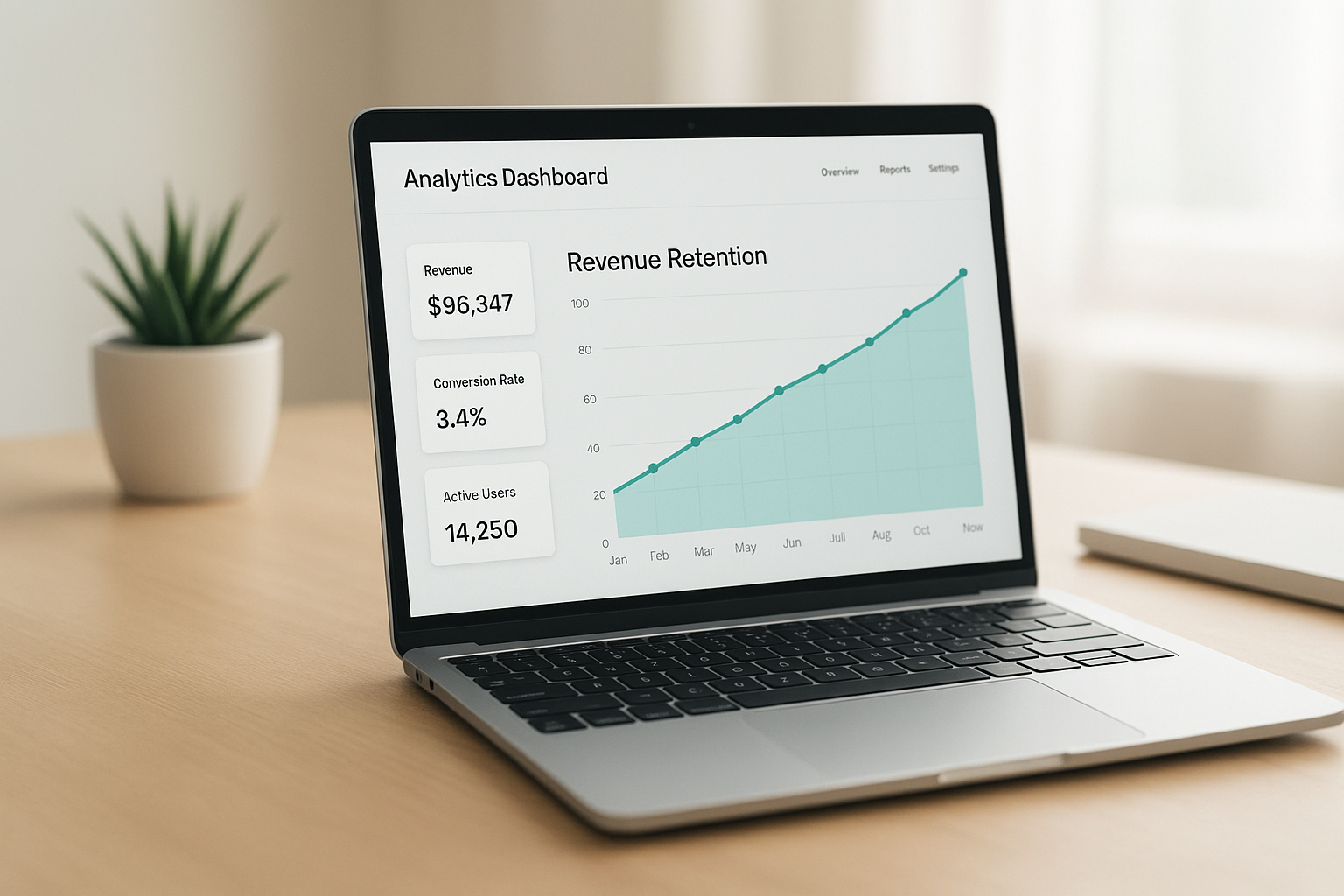
Tracking revenue retention trends day to day helps teams catch risk before a renewal conversation.
Why Revenue Retention Matters for Service Businesses
Service businesses depend on recurring revenue from retainers, subscriptions, and repeat engagements. As a result, a small decline in retention has an outsized effect on growth because every lost client must be replaced with new sales just to stand still.
Research widely cited in Harvard Business Review shows that increasing customer retention by just 5% can increase profits by 25% to 95%, depending on the industry. In contrast, acquisition spend rarely produces returns that fast. Consequently, agencies and consultancies that treat client retention as a core discipline, rather than a byproduct of good work, tend to compound revenue far more reliably.
Specifically, this matters most for firms on retainers: marketing agencies, consultancies, coaching businesses, and fractional executive practices, where every active client represents months or years of predictable revenue. If you want a deeper breakdown of how churn erodes agency revenue, the guide on reducing client churn covers the mechanics in more detail.
How to Calculate Revenue Retention Rate
The basic formula is simple: take the recurring revenue retained at the end of a period, divide it by the recurring revenue you started with, then multiply by 100. The tricky part is deciding what counts as "retained."
- Identify your starting recurring revenue at the beginning of the period, for example the first day of the quarter.
- Subtract revenue lost to cancellations and downgrades during that period.
- For gross revenue retention, stop here and divide the result by the starting figure.
- For net revenue retention, add back any expansion revenue from upsells, add-ons, or renewed contracts at higher value.
- Divide the final number by the starting revenue and multiply by 100 to get your percentage.
If manual tracking feels error-prone, a revenue retention calculator can run this formula automatically against your actual account data.
Net Revenue Retention vs. Gross Revenue Retention
These two numbers answer different questions, and confusing them leads to misleading reports. Gross revenue retention is capped at 100% because it only measures what was lost; it never includes new growth from existing clients. Net revenue retention, on the other hand, can exceed 100% because it credits the business for expansion, such as a client upgrading their retainer or adding a new service line.
In practice, both numbers matter. Gross revenue retention reveals how well you are protecting the base. Net revenue retention reveals how well you are growing it. A firm with strong net retention but weak gross retention may be hiding churn behind a few large expansion deals.
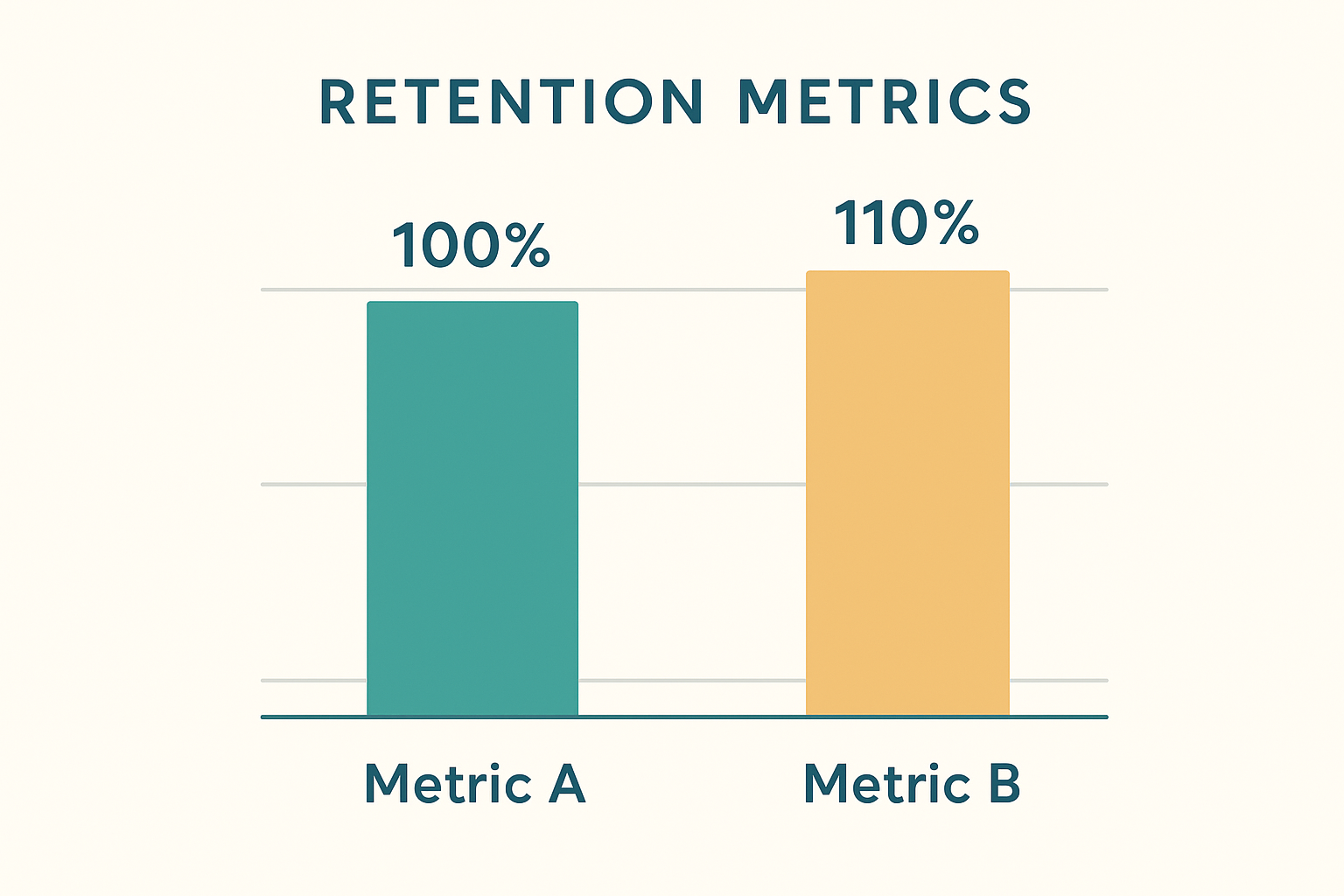
Comparing gross and net revenue retention side by side reveals where growth is really coming from.
What Is a Good Revenue Retention Benchmark?
Most established service businesses should aim for gross revenue retention above 90% and net revenue retention above 100%. In particular, firms that consistently expand accounts through upsells or added scope often land between 105% and 115% net retention, which is considered strong performance in recurring revenue models.
However, benchmarks vary by niche. A coaching business with shorter engagements may see more natural turnover than a marketing agency on 12-month retainers. As a result, it is more useful to track your own trend line over time than to chase an industry average blindly. For context on related scoring methods, see the guide on client retention scores.
How to Improve Revenue Retention
Improving revenue retention is a process, not a single fix. The following steps give service businesses a repeatable path to raise retention over a quarter or two.
- Audit every client relationship. Review engagement level, contract value, and sentiment for each account so you know exactly where revenue is exposed before building a fix.
- Build a continuous health score. Combine CRM activity, billing status, meeting frequency, and support signals into one ongoing score so declining relationships surface automatically.
- Standardize the first 30 days. Map a clear onboarding journey with milestones so early expectations are met and the relationship starts on stable footing.
- Design churn intervention playbooks. Create specific response plays for at-risk accounts, including who contacts the client and what fix is proposed within a defined timeframe.
- Review renewal and expansion signals weekly. Set a recurring cadence to check upcoming renewals and usage trends so the team acts before a decision is already made.
Common Revenue Retention Mistakes to Avoid
Many teams track revenue retention only once a quarter, which means risk is often discovered after a client has already decided to leave. Similarly, relying on a single relationship owner's gut feeling, instead of structured signals like usage and billing data, creates blind spots across a growing portfolio.
Another frequent mistake is treating onboarding as an afterthought. Because the first 30 days set the tone for the entire relationship, a weak start is one of the strongest predictors of early churn. For a closer look at churn triggers specific to agencies, the marketing agency retention solution page outlines where these risks typically surface.
How ClientBloom Helps Improve Revenue Retention
ClientBloom is a client retention operating system built for agencies and service businesses that already have an established client base. It connects to the tools a team already uses, such as the CRM, billing platform, meeting calendar, and call transcripts, through read-only integrations, so no replacement of existing systems is required.
Each day, ClientBloom's Business Intelligence Agent scores the health of every client relationship and delivers a morning brief to Slack, email, text, or Telegram that tells the team who to call, why, and what to do next. This continuous Client Retention Score, paired with renewal and expansion surfacing, gives account teams the kind of early warning that manual quarterly reviews simply cannot match.
You can explore how the installation process, retention playbooks, and dashboard work together at clientbloom.ai, or browse the full library of retention guides for deeper tactical breakdowns.

Daily morning briefs turn revenue retention from a quarterly surprise into a weekly habit.
Frequently Asked Questions About Revenue Retention
What is revenue retention?
Revenue retention is the percentage of recurring revenue a business keeps over a given period, typically measured monthly or annually. It excludes new sales and focuses only on revenue from existing clients.
How do you calculate revenue retention rate?
Divide the revenue retained from existing clients at the end of a period by the revenue you started with at the beginning of that period, then multiply by 100. Expansion revenue is included for net retention and excluded for gross retention.
Why does revenue retention matter more than new sales growth?
Acquiring a new client typically costs far more than keeping an existing one, so losses in recurring revenue quietly erase the gains from new sales. A service business with strong revenue retention grows faster with less acquisition spend.
What is the difference between gross and net revenue retention?
Gross revenue retention measures only what was lost to downgrades and churn, capped at 100%. Net revenue retention adds back expansion revenue from upsells and renewals, so it can exceed 100%.
What is a good revenue retention benchmark?
Most established service businesses aim for gross revenue retention above 90% and net revenue retention above 100%. Top-performing agencies and consultancies often exceed 110% net retention through consistent expansion.
How much does poor revenue retention cost a service business?
Even a small drop in retention compounds quickly because lost accounts must be replaced with new sales just to stay flat. Research widely cited by Bain and Harvard Business Review shows that a 5% improvement in retention can lift profits by 25% to 95%.
How long does it take to improve revenue retention?
Most teams see measurable improvement within one to two quarters once onboarding, health scoring, and intervention playbooks are in place. Full benchmark gains, such as moving net retention from 90% to 105%, usually take two to four quarters.
What are the most common revenue retention mistakes?
The most common mistakes are relying on lagging indicators like renewal date alone, skipping structured onboarding, and reacting to churn only after a client has already decided to leave. These gaps hide risk until it is too late to intervene.
What tools help track revenue retention?
CRM reporting, billing platforms, and dedicated client retention software all contribute data. Platforms that combine CRM, billing, and communication signals into one continuous health score give the clearest early warning, as described in the churn rate literature.
How often should revenue retention be reviewed?
Leadership should review portfolio-level revenue retention monthly, while individual account health should be checked weekly or daily through automated alerts. Quarterly business reviews are a useful checkpoint for deeper trend analysis.
Does revenue retention apply to non-SaaS service businesses?
Yes, revenue retention applies to any business with recurring revenue, including marketing agencies, consultancies, coaching businesses, and fractional executive firms. The formula is identical regardless of whether the revenue comes from software subscriptions or retainer contracts.
What role does client onboarding play in revenue retention?
Onboarding sets the tone for the entire relationship, and a weak first 30 days is one of the strongest predictors of early churn. Structured onboarding with clear milestones directly protects revenue retention in the first year.
How does churn rate relate to revenue retention?
Churn rate measures how many clients or how much revenue you lose, as defined on Investopedia, while revenue retention measures the inverse: what you kept. They describe the same underlying relationship from opposite directions.
Revenue retention is the single number that reveals whether a service business is truly growing or just replacing what it loses. By calculating gross and net revenue retention regularly, benchmarking against realistic targets, and investing in onboarding and early-warning scoring, agencies and consultancies can protect the recurring revenue they have already earned. Above all, treating revenue retention as a daily discipline, rather than a quarterly surprise, is what separates firms that compound growth from those that stall.

