
Renewal and Retention Management Software: 2026 Guide
Renewal and retention management software gives service businesses a single, reliable view of whether a client relationship is thriving or quietly drifting toward cancellation. For agencies, consultancies, and other recurring-revenue teams, that visibility is the difference between a predictable renewal and a surprise termination email. This guide breaks down exactly what this software category does, how it differs from a CRM, which features actually move the needle, and how to implement one without burning a quarter on a half-finished rollout. By the end, you will know precisely how to evaluate, deploy, and run a system that protects revenue you have already earned.
Direct answer: Renewal and retention management software is a platform that continuously scores client relationship health, alerts teams to at-risk accounts, and surfaces renewal or expansion opportunities before a contract lapses. It works alongside your CRM rather than replacing it, and it goes well beyond a simple renewal date reminder tool.
What Is Renewal and Retention Management Software?
Renewal and retention management software is a system built specifically to protect recurring revenue after a deal closes. Unlike sales-focused tools, it watches what happens during the life of the relationship: how often a client engages, what sentiment shows up in calls and emails, whether invoices are paid on time, and whether onboarding milestones were ever completed.
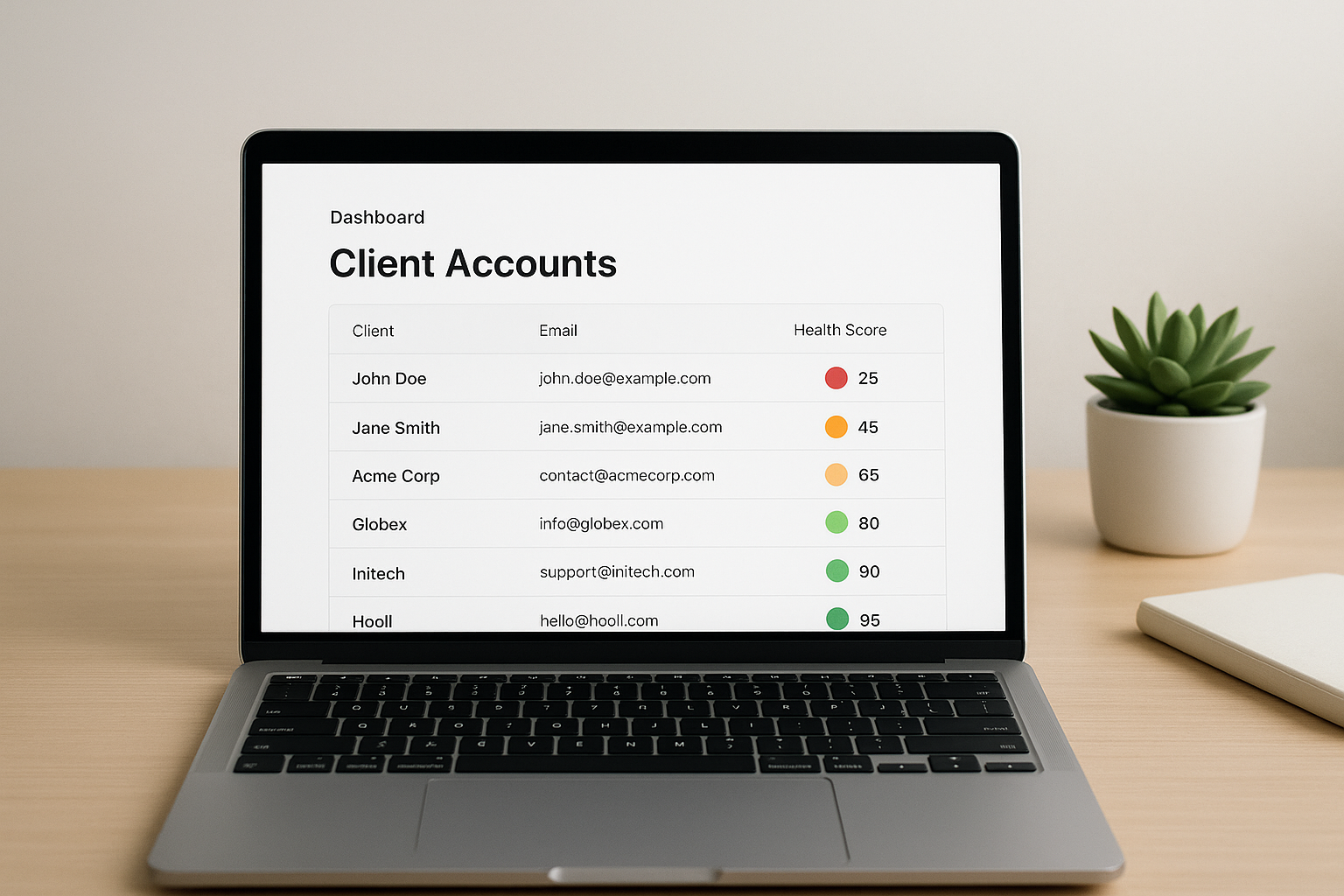
In practice, the software connects to tools a team already uses, such as a CRM, billing platform, meeting software, and project management system. Consequently, it builds a composite health score for each account, often on a 0 to 10 scale, and updates that score as new data arrives. For example, a sudden drop in meeting attendance combined with a late invoice might lower a score enough to trigger an alert days before a human would notice the pattern unassisted. This is what separates true renewal and retention management software from a basic calendar reminder: it reads behavior, not just dates.
A well-built renewal and retention management software dashboard turns scattered client signals into one clear health score.
How a Retention Management System Differs From a CRM
Many teams assume their CRM already covers this need, but a CRM is primarily a record-keeping tool for contacts and pipeline stages. A retention management system, on the other hand, interprets ongoing behavior and produces an action-oriented score. For this reason, retention software is designed to integrate with a CRM rather than replace it, pulling data out instead of duplicating what already lives there. In short, a CRM tells you who your clients are; a retention platform tells you how they are actually doing right now.
Why Client Retention Platforms Matter More Than Ever in 2026
Service businesses that bill on retainer depend on renewals the way product companies depend on repeat purchases. Therefore, losing even a handful of accounts each quarter can erase months of new sales effort. According to research popularized by Harvard Business Review and widely cited analysis from Bain & Company, increasing customer retention rates by just 5% can increase profits by 25% to 95%, depending on the industry.
That statistic matters because most agencies and consultancies already have the clients; they simply lack a system for watching them closely. In contrast, a dedicated client retention platform turns scattered observations, a missed call here, a slow email reply there, into a single, trackable signal the whole team can act on. As a result, retention becomes a daily discipline rather than a quarterly fire drill handled only during renewal season.
The Real Cost of Ignoring Renewal Risk
Consider a 20-client agency billing $8,000 per month per account. Losing just two clients a year to preventable churn, often referred to as customer attrition, erases nearly $200,000 in annual revenue. Specifically, most of that loss is preventable because the warning signs, fewer replies, missed meetings, stalled projects, typically surface weeks before a cancellation notice. Without a system watching for those signals, however, the first clear sign a team gets is often the renewal conversation itself, by which point it is usually too late to change the outcome.
Core Features of Renewal and Retention Management Software
Not every tool in this category offers the same depth. However, the strongest renewal and retention management software options share a common set of capabilities that work together rather than in isolation. If you are comparing vendors, use this list as your evaluation checklist before you read a single feature page.
- Continuous health scoring: a 0–10 relationship score updated daily, not just at renewal time.
- Read-only integrations: connections to CRM, billing, meetings, projects, and call transcripts without disrupting existing systems.
- Morning briefs: daily summaries sent to Slack, email, text, or Telegram showing who to call and why.
- Churn intervention playbooks: predefined escalation steps triggered automatically when a score drops.
- Renewal and expansion surfacing: proactive flags for upsell or renewal conversations based on account trends.
- Analytics dashboards: portfolio-level views of churn forecasts and engagement trends over time.
- Contract and renewal-date tracking: automated alerts as renewal windows approach, layered on top of behavioral risk data rather than used alone.
Health Scoring: The Engine Behind Renewal and Retention Management Software
The health score is the single most important feature to evaluate. Above all, it should combine multiple inputs, engagement frequency, sentiment, billing status, and onboarding progress, into one number your team can glance at and understand instantly. In particular, avoid any platform that only tracks a single metric, such as login frequency or ticket volume, since a narrow score produces false confidence and misses the compound signals that actually predict churn.
Integrations That Make a Retention Platform Work
Similarly, integration depth determines whether a score reflects reality or a partial guess. A platform that only connects to your CRM, for instance, misses billing friction and call sentiment entirely. Therefore, insist on read-only connections to your CRM, billing system, meeting and call-transcript tools, project management software, and automation platforms such as Zapier before signing a contract.

Morning briefs turn renewal and retention management software insights into a daily team habit.
Renewal and Retention Management Software vs. Basic Renewal Tracking Tools
It is worth being specific here, because many tools marketed as "renewal management" solve a much narrower problem: they simply watch contract end dates and send reminder emails. That is useful, but it is not the same thing as retention management. In contrast, true renewal and retention management software predicts risk from behavior long before a renewal date even appears on the calendar.
- Basic renewal tracking tools: monitor contract dates and send reminders as deadlines approach. They tell you when a decision is coming, not whether the client is happy.
- Renewal and retention management software: scores ongoing engagement, sentiment, and billing health every day, flags risk weeks or months ahead of a contract date, and recommends a specific intervention.
- The practical difference: one gives you a calendar notification; the other gives you a reason and a plan of action before the calendar notification would have fired.
For a deeper comparison of vendors in this space, agencies evaluating multiple options often find it useful to review a dedicated buyer's guide to client retention software for agencies before shortlisting a platform.
How to Choose and Implement a Renewal Tracking System
Selecting the right platform is less about feature counts and more about fit with how a team already operates. The following steps outline a practical path from evaluation to a fully working setup.
- Audit current client data. Map where client information already lives, including the CRM, billing system, meeting tools, and project software, before adding anything new.
- Connect read-only integrations. Link the platform to existing tools so data flows automatically without disrupting current workflows or requiring manual entry. Teams that want a deeper walkthrough of this step can review this guide to reducing client churn for a breakdown of early warning signals worth tracking.
- Configure the client health score. Decide which inputs matter most, such as engagement, sentiment, billing status, and onboarding progress, and set their weighting.
- Design escalation and renewal playbooks. Build specific intervention plays for at-risk accounts and a renewal workflow that activates automatically as contract dates approach.
- Train the team on daily usage. Walk account managers through the morning brief and dashboard so alerts become consistent daily action rather than another unread notification.
- Monitor and refine monthly. Review which score thresholds actually predicted churn versus false alarms, then adjust weighting so the system gets sharper with every renewal cycle.
Who Should Use a Client Retention Management System
This category of software fits best with established service businesses that already manage a meaningful book of active client relationships, such as marketing agencies on retainers, consultancies, coaching and expert businesses, and fractional executive practices. In particular, teams juggling more accounts than any single person can track manually benefit the most, since the software replaces memory and spreadsheets with a consistent daily signal.
ClientBloom, for instance, is built specifically as a client retention operating system for these kinds of businesses. It connects to tools already in use, scores every relationship daily, and sends a morning brief naming exactly who needs attention and why. You can see the full platform on the ClientBloom software page. Businesses looking to formalize their renewal process can explore how to systematize renewals across an entire portfolio, while operations leads may prefer the overview built for operations managers who own the retention process end to end.
When This Software Is Not the Right Fit
On the other hand, solo operators managing only a handful of clients, or businesses that are pre-revenue, typically will not see enough volume to justify a dedicated retention platform. Similarly, teams searching for a CRM replacement should look elsewhere, since this software is designed to integrate with an existing CRM rather than substitute for one.
Common Mistakes When Implementing Retention Software
Even strong platforms fail to deliver results when the rollout skips important groundwork. Above all, teams run into trouble when they connect data sources but never redesign the escalation workflow around the new scores, leaving alerts to pile up unanswered. Furthermore, skipping team training is a frequent misstep; a dashboard full of accurate scores is worthless if nobody acts on it consistently.
Another common mistake is treating implementation as a side project instead of a focused sprint. Businesses considering whether to hire another customer success manager instead of adopting software should first review the comparison before hiring another CSM, since in many cases the software extends existing team capacity rather than requiring new headcount.
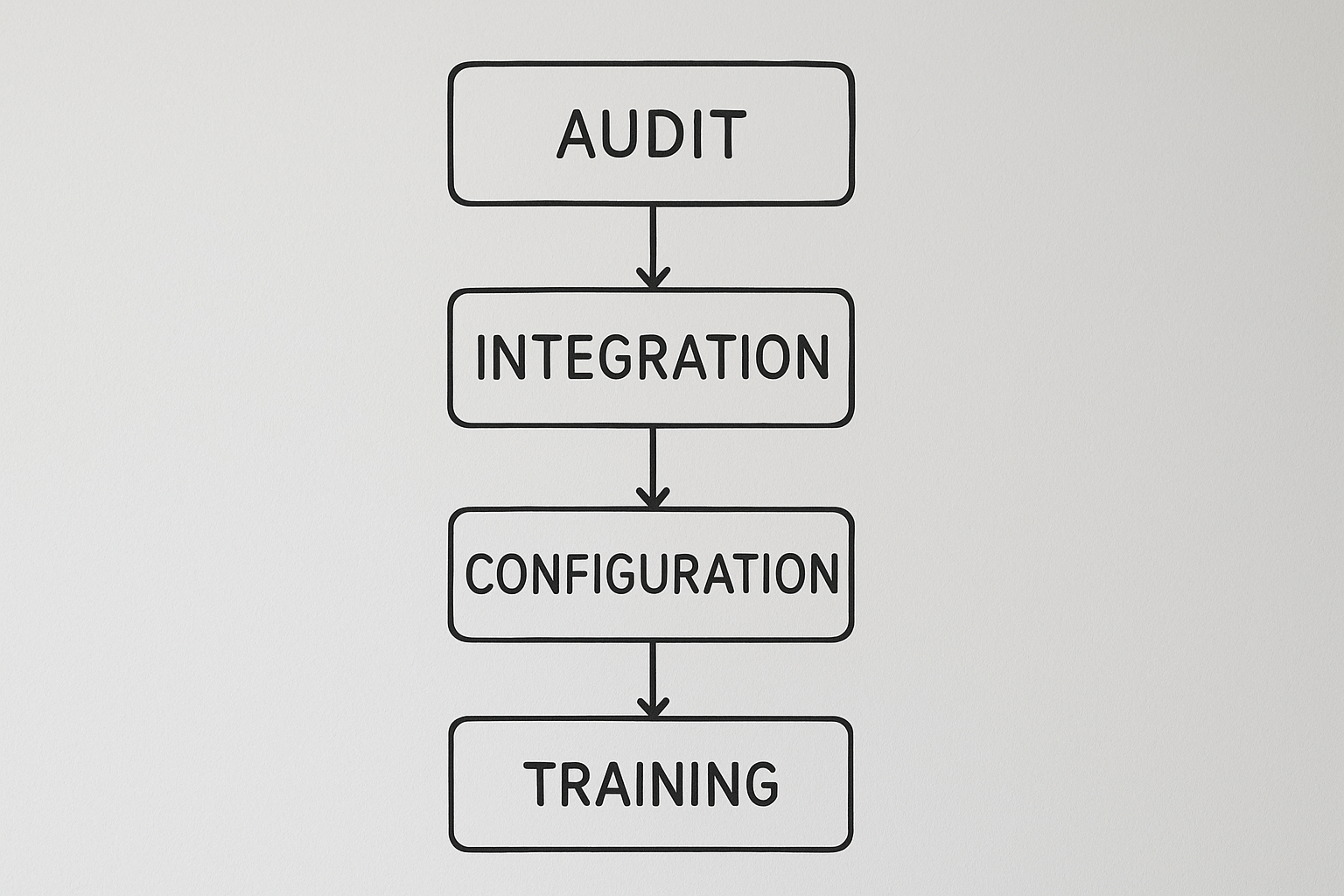
A structured rollout plan keeps renewal and retention management software implementation on schedule.
Pricing and ROI: What Renewal and Retention Management Software Really Costs
Pricing varies by provider, portfolio size, and whether implementation support is included. Generally speaking, you will encounter three pricing patterns: per-account monthly fees, flat monthly platform fees regardless of portfolio size, and bundled packages that fold setup, training, and ongoing monitoring into one subscription. Platforms built for established agencies and consultancies tend to favor the bundled approach, since it removes the risk of a stalled, self-managed rollout.
To judge ROI, run a simple calculation. Suppose a 15-client agency retains an average of $6,000 per month per client, or $1.08 million annually across the portfolio. If renewal and retention management software prevents the loss of just one client that would otherwise have churned, it has already paid for itself many times over, since most platforms in this category cost a fraction of a single client's annual value. For a closer look at how retention rate connects directly to top-line revenue, see this breakdown of how to keep more of your revenue.
Key Metrics Every Retention Management System Should Track
A client retention score typically blends several inputs into a single rating, but it helps to understand each one individually before trusting a composite number.
- Engagement frequency: meeting attendance, email responsiveness, and platform logins, where applicable.
- Sentiment: tone trends detected across call transcripts and written communication over time.
- Billing health: on-time payments versus late invoices or repeated billing disputes.
- Onboarding completion: whether early milestones were finished on schedule, since stalled onboarding strongly predicts later churn.
- Support ticket trends: rising ticket volume or unresolved issues, which often precede a cancellation conversation.
In addition, many teams track portfolio-level figures such as gross and net revenue retention alongside individual account health scores. For a broader library covering these concepts in more depth, browse the full set of client retention guides available on ClientBloom.
Frequently Asked Questions About Renewal and Retention Management Software
What is renewal and retention management software?
Renewal and retention management software is a platform that tracks the health of client relationships, flags at-risk accounts, and surfaces renewal and expansion opportunities before contracts lapse. It typically connects to a CRM, billing system, and communication tools to score every account continuously.
How does renewal and retention management software reduce churn?
It reduces churn by scoring client health daily and alerting teams the moment engagement, sentiment, or usage drops. This gives account managers time to intervene with a specific play instead of discovering the problem at renewal time.
Why do service businesses need retention management software?
Service businesses rely on recurring revenue from retainers and renewals, so a missed warning sign can cost a contract. Retention software replaces guesswork with consistent, documented monitoring across every account.
How is renewal and retention management software different from a CRM?
A CRM stores contact records and sales pipeline data, while retention software analyzes ongoing relationship signals after the sale closes. The two tools integrate rather than compete, with the retention platform reading data from the CRM to generate health scores.
How much does retention management software cost?
Pricing varies by provider, portfolio size, and whether implementation support is included. Platforms built for established agencies and consultancies often bundle setup, training, and ongoing monitoring into a single monthly cost.
How long does it take to implement a client retention platform?
A focused implementation can take as little as one week when it includes an audit, integration setup, and team training in a structured sprint. Self-guided rollouts without dedicated support usually take considerably longer.
What are common mistakes when adopting renewal tracking software?
The most common mistake is connecting data sources without redesigning the renewal and escalation workflow around the new scores. Teams also fail when they skip training on how to act on alerts, not just read them.
What integrations should renewal and retention management software support?
Look for read-only connectors to your CRM, billing platform, meeting and call transcript tools, project management software, and automation tools like Zapier. Broad integration coverage ensures the health score reflects real client behavior, not a partial view.
Can small businesses use retention management software?
These platforms are built for established service businesses managing multiple active client relationships, such as agencies, consultancies, and fractional executive practices. They are generally not designed for solo operators with only a handful of clients or pre-revenue companies.
What metrics does a client retention score track?
A client retention score typically blends engagement frequency, sentiment from calls and emails, billing status, onboarding milestone progress, and support ticket trends into a single 0 to 10 rating. The goal is one number that reflects relationship health at a glance.
How does a morning brief help with renewals?
A morning brief delivered to Slack, email, or text tells each team member which accounts need attention that day and why. This turns renewal management from a quarterly scramble into a daily habit.
What is the ROI of investing in renewal and retention management software?
Because retaining an existing client is far cheaper than acquiring a new one, even a small improvement in renewal rates can meaningfully increase recurring revenue. Research popularized by Bain & Company found that a 5% increase in customer retention can increase profits by 25% to 95%.
Does renewal and retention management software replace customer success managers?
No, it supports customer success managers rather than replacing them by handling data aggregation and alerting so humans can focus on relationship work. Some teams use it to extend the capacity of a lean CSM team before adding headcount.
How does ClientBloom's installation process work?
ClientBloom runs a one-week installation that includes an account audit, platform and integration configuration, and team training on the retention playbook. The result is a working renewal and retention management software setup without a long, self-managed rollout, as described on clientbloom.ai.
What is the difference between renewal management and retention management?
Renewal management focuses narrowly on the event of a contract ending, tracking dates and reminders. Retention management is broader: it monitors relationship health continuously, long before a renewal date, so that renewal becomes a formality rather than a negotiation.
Does renewal and retention management software work for multi-year contracts?
Yes. In fact, multi-year contracts benefit the most, since infrequent renewal conversations make it easy for a relationship to quietly deteriorate for months without anyone noticing. Continuous health scoring closes that visibility gap regardless of contract length.
Conclusion: Protect the Revenue You Already Earned
In the end, renewal and retention management software is less about adding another tool and more about protecting revenue a business has already earned. By scoring client health daily, surfacing renewal opportunities early, and sending clear daily action items, this kind of platform turns retention from a quarterly guess into a repeatable process. Service businesses that depend on recurring revenue, from agencies to consultancies to fractional executive practices, stand to gain the most from putting one in place. For teams ready to see this in action, exploring a purpose-built option such as ClientBloom is a reasonable next step toward keeping more of the revenue already won.

