

Client Retention Software for Agencies: Buyer's Guide
Client retention software for agencies is purpose-built technology that continuously tracks the health of every client relationship, flags accounts at risk of leaving, and tells account teams exactly who to contact and why — before a cancellation email ever lands in an inbox. For agencies running on retainer revenue, losing even a handful of clients each year can quietly erode months of new-business effort. This guide goes further than a typical software roundup: it explains what client retention software for agencies actually does, how it differs from a CRM and a project management tool, what it costs, how to roll it out without wasting the first 90 days, and which mistakes sink adoption before it ever pays off.
Quick answer: Client retention software for agencies combines relationship scoring, at-risk alerts, and daily briefings into one system so account teams can act before a client churns, rather than after. It is not a replacement for your CRM or project tracker — it sits on top of both and watches the signals they miss.
Client retention software for agencies turns scattered signals into one daily view of relationship health.
What Is Client Retention Software for Agencies?
Client retention software for agencies is a category of platform designed specifically for teams that manage ongoing client relationships — think marketing agencies, consultancies, coaching businesses, and professional service firms billing on retainer. Unlike a CRM (customer relationship management system, a tool that primarily tracks contacts and sales deals), a retention platform continuously monitors the signals that predict churn: meeting cadence, response times, invoice status, and sentiment captured in call transcripts.
For example, ClientBloom connects as a read-only layer (meaning it can view data but never alters it) on top of the tools an agency already uses — its CRM, billing platform, calendar, and project management software — and assigns every account a Client Retention Score between 0 and 10. As that score shifts, an AI-powered client services manager surfaces the reason and recommends a next step, rather than leaving an account manager to notice the warning signs alone.
In other words, this is not just another place to log notes. It is a monitoring layer that watches relationships the way a security system watches a building — quietly, continuously, and only speaking up when something needs attention.
Why Agencies Can't Rely on a CRM or Project Management Tool Alone
Most agencies already run at least two systems: a CRM for sales and a project management tool for delivery. Neither one, however, was built to answer the question that actually determines revenue stability — "which of our current clients is quietly disengaging right now?" A CRM stops paying attention once a deal closes. A project tool tracks tasks and deadlines, not whether a client feels valued. As a result, agencies often discover churn only when a client sends the cancellation notice, by which point it's too late to intervene.
This is precisely the gap client retention software for agencies is designed to close. Rather than adding a third disconnected tool, the strongest platforms sit alongside the CRM and the project manager, pulling signals from both — and from billing and call data too — to build a single, continuously updated picture of relationship health.
CRM vs. Project Management Software vs. Retention Platform
| Aspect | CRM | Project Management Tool | Retention Platform |
|---|---|---|---|
| Primary purpose | Track contacts and deals | Track tasks and deliverables | Track relationship health over time |
| Data focus | Sales pipeline stages | Due dates, task status | Engagement, sentiment, billing signals |
| Alerts | Manual reminders | Overdue task flags | Automated at-risk escalation |
| Primary user | Sales team | Delivery and project teams | Account and CSM team |
Why Retention Matters More Than New Business
Furthermore, the economics of retention are well documented. Research popularized by Harvard Business Review found that increasing customer retention rates by just 5% can increase profits by 25% to 95%, depending on the industry. For an agency, that means protecting a handful of retainer clients often matters more than closing new logos. The broader concept, known as customer retention, has become a core growth lever for service businesses of every size. For a formal definition of how CRMs fit into this picture, Gartner's CRM industry glossary is a useful reference point.
In addition, service businesses face a particular challenge: client relationships are managed by individual account managers, and knowledge about relationship health often lives in someone's head rather than in a system. When that person is busy, on vacation, or leaves the company, warning signs get missed. As a result, churn frequently arrives as a surprise rather than a predictable, preventable event.
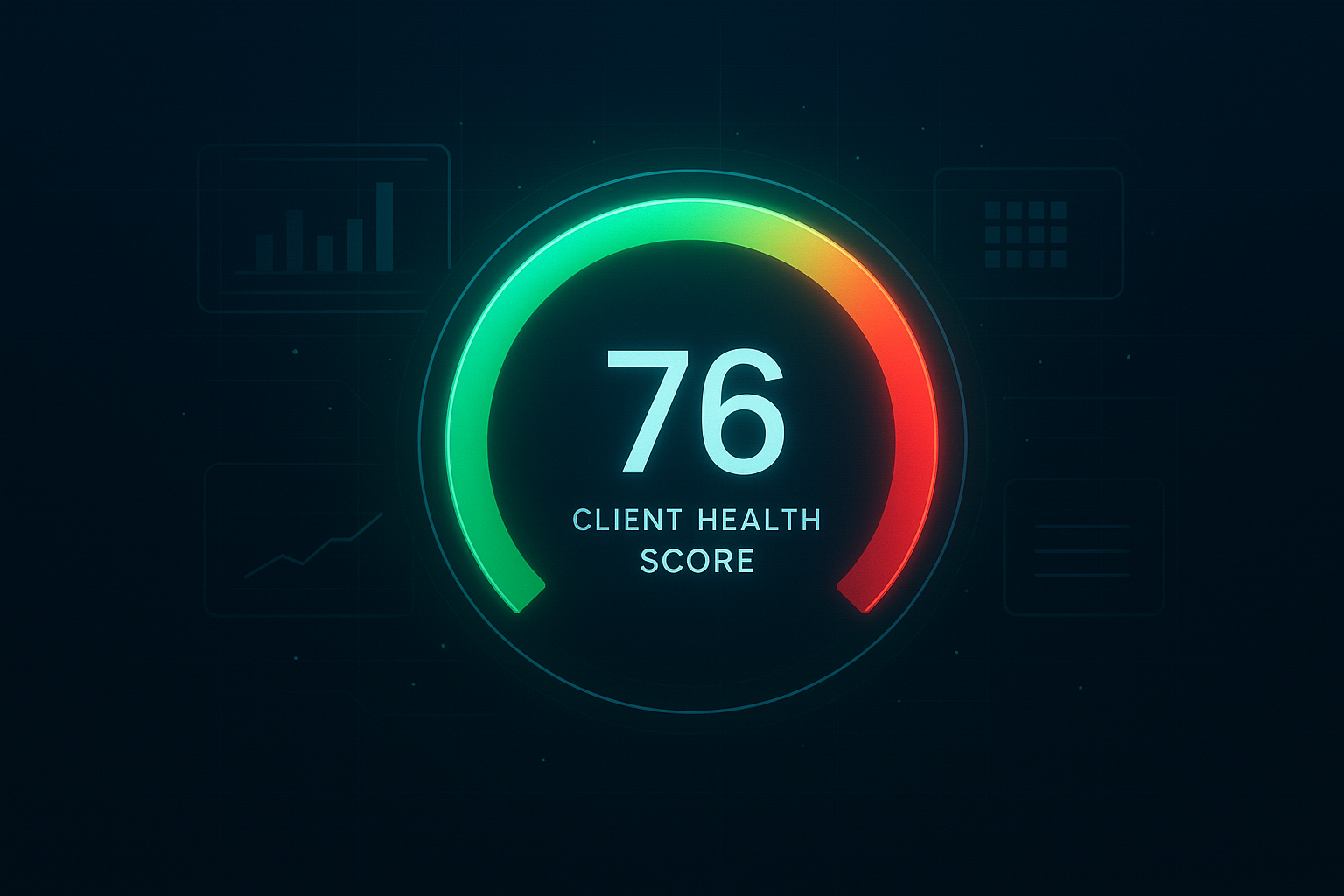
A continuous 0–10 score gives agencies an early signal before a client disengages.
Key Features of Client Retention Software for Agencies
Not all client retention software for agencies works the same way. Specifically, the capabilities below matter most for service businesses managing multiple ongoing accounts.
- Continuous 0–10 relationship health scoring, updated daily rather than quarterly.
- Read-only integrations with CRM, billing, meeting, project, and call-transcript tools.
- Automated at-risk escalation protocols and churn intervention playbooks.
- Daily morning briefs delivered to Slack, email, text, or Telegram.
- Renewal and expansion opportunity surfacing built into the same workflow.
- Ask-anything natural-language queries for fast, plain-English answers about any account.
How Client Retention Scoring Works
Above all, understanding the mechanics behind the score helps teams trust it. Here is the typical process a client health scoring software platform follows:
- Connect your tools — the platform links to your CRM, billing system, meeting calendar, project management tool, and call transcripts through secure, read-only integrations, so no data migration is required and nothing you already use gets disrupted.
- Analyze engagement signals — the system reviews meeting frequency, response times, invoice status, and sentiment captured in call transcripts to see how each relationship is trending over days and weeks, not just at the quarterly check-in.
- Calculate a health score — each client account receives a continuous score, often on a 0 to 10 scale, reflecting the overall strength of the relationship at that exact moment in time.
- Flag at-risk accounts — when a score declines past a threshold, the platform triggers an alert and recommends a specific intervention play so the account manager knows precisely what to do next.
- Deliver a morning brief — a daily summary is sent to Slack, email, text, or Telegram naming exactly which clients need attention today, why they were flagged, and what action is suggested.
What Does Client Retention Software Cost for Agencies?
Naturally, cost is one of the first questions agency owners ask. Pricing for retention tools for agencies typically scales with the number of active client accounts under management rather than the number of internal seats, which keeps costs predictable as the team grows. Most vendors use a monthly subscription model, and many charge a one-time setup or installation fee that covers the initial audit and integration work.
Consequently, the real cost comparison isn't software fee versus software fee — it's software fee versus the revenue lost to a single surprise cancellation. An agency billing $4,000 a month per retainer client loses far more to one unexpected churn event than it would ever spend on a year of client retention software for agencies. For a deeper breakdown of renewal economics specifically, see this 2026 renewal and retention management guide.
Retention Platform vs. CRM: What's the Difference?
Consequently, agencies often ask whether retention software replaces their CRM. It does not — a retention platform is designed to integrate with, not replace, the CRM your team already relies on.
| Aspect | CRM | Retention Platform |
|---|---|---|
| Primary purpose | Track contacts and deals | Track relationship health over time |
| Data focus | Sales pipeline stages | Engagement, sentiment, billing signals |
| Alerts | Manual reminders | Automated at-risk escalation |
| Primary user | Sales team | Account and CSM team |
How to Choose the Right Retention Platform for Your Agency
Similarly, choosing between retention tools for agencies comes down to a few practical questions. First, does the platform integrate with your existing stack without requiring you to abandon your CRM? Second, how fast can it be installed — some vendors offer a done-with-you, one-week setup that includes an audit, configuration, and team training, while others expect months of self-serve onboarding.
Third, consider fit. Retention platforms are generally built for established service businesses with an existing base of active clients — such as the agencies described in this marketing agency retention guide — rather than solo operators with only a couple of accounts. Finally, ask whether the platform can support a leaner client success team; some agencies use retention software specifically to delay or avoid an additional CSM hire while still covering a growing portfolio.
A Quick Vendor Scorecard
Before signing a contract, score each vendor against this checklist:
- Does it connect to your CRM and billing tool without migration?
- Is scoring continuous, or only refreshed on a manual schedule?
- Can alerts route to the channel your team actually checks daily?
- Does setup take days, not months?
- Is pricing tied to active clients, so costs stay predictable as you grow?
Common Mistakes Agencies Make When Adopting Retention Tools
Even strong software fails when it is treated as an afterthought. Therefore, watch for these avoidable mistakes:
- Treating the dashboard as a report to glance at, instead of building daily workflows around it.
- Skipping CSM training and compensation alignment, so scores never translate into action.
- Ignoring onboarding and the first 30 days, when most early churn risk actually begins.
- Failing to define clear churn intervention playbooks before a client is already flagged as at-risk.
For a deeper look at fixing these patterns, this guide on reducing client churn walks through intervention playbooks step by step, and the broader resource library covers onboarding design and CSM ramp planning in more detail.
Daily briefs turn retention scoring into a concrete, actionable to-do list.
Client Retention Software vs. General Client Management Software
It's worth addressing a common point of confusion directly. "Client management software" is a broad umbrella that includes invoicing tools, proposal tools, project trackers, and general CRMs — useful systems, but none of them are purpose-built to predict churn. Client retention software for agencies is a narrower, more specialized category that exists for one job only: protecting recurring revenue by catching disengagement early. Agencies that rely solely on general-purpose client management software often have plenty of data about what happened, but very little warning about what's about to happen.
Frequently Asked Questions About Client Retention Software for Agencies
What is client retention software for agencies?
Client retention software for agencies is a platform that continuously scores the health of every client relationship, flags accounts at risk of leaving, and tells account teams who to contact and why. It differs from a CRM by focusing on ongoing relationship signals rather than just contact and deal records.
How does client retention software for agencies work?
It connects to existing tools such as a CRM, billing system, calendar, and call transcripts through read-only integrations, then analyzes engagement patterns to calculate a health score for each client. When a score drops, the platform alerts the account team and suggests an intervention.
Why do agencies need retention software instead of just a CRM?
A CRM tracks contacts, deals, and pipeline stages, but it rarely detects a quietly disengaging client. Retention software fills that gap by monitoring meeting cadence, response times, and sentiment to predict churn before a client cancels.
How is client retention software different from project management tools?
Project management tools track tasks, deadlines, and deliverables for work already underway. Client retention software instead monitors relationship-level signals like engagement, sentiment, and billing status to flag risk before it shows up as a missed deadline or a cancellation.
How much does client retention software for agencies cost?
Pricing varies by vendor and typically scales with the number of active client accounts managed on the platform. Most retention platforms are priced as a monthly subscription, often with an initial setup or installation fee.
How long does implementation take?
Many modern platforms, including done-with-you options, can be configured and connected within about one week, covering an audit, integrations, and team training. The timeline can vary depending on how many tools need to be connected.
What is a client retention score?
A client retention score is a continuous rating, often on a 0 to 10 scale, that reflects the overall strength and stability of a client relationship. It typically updates daily based on engagement, billing, and communication signals.
What mistakes do agencies make when adopting retention software?
The most common mistake is treating the platform as a passive dashboard instead of building it into daily workflows and playbooks. Skipping team training and ignoring the first 30 days of client onboarding also weaken results.
What features should agencies look for in retention software?
Look for continuous health scoring, read-only integrations with tools you already use, automated at-risk alerts, and daily briefs delivered to Slack, email, text, or Telegram. Renewal and expansion surfacing are also valuable for growth.
Can retention software replace a customer success manager?
Retention software does not replace a customer success manager; instead, it acts as an AI-powered assistant that surfaces which accounts need human attention. This lets a smaller CSM team manage a larger portfolio of clients effectively.
Does client retention software integrate with existing tools?
Yes, most retention platforms connect through read-only connectors to CRMs, billing systems, meeting tools, project management software, and call transcripts. This approach means teams keep their existing CRM rather than migrating data.
What results can agencies expect from client retention software?
Agencies typically see fewer surprise cancellations and faster intervention on at-risk accounts once relationship health becomes visible daily. Industry research has found that a 5% increase in retention can raise profits by 25% to 95%.
Is client retention software for agencies worth it for small agencies?
It is generally built for established service businesses managing multiple ongoing client relationships, not solo operators with only a handful of accounts. For agencies with five or more active clients, the visibility it provides is usually worth the investment.
How is retention software different from a quarterly business review (QBR)?
A quarterly business review, or QBR, is a periodic, structured check-in, while retention software monitors relationship health continuously between those reviews. Together, daily monitoring and scheduled QBRs give a fuller picture of client satisfaction.
Conclusion
Ultimately, client retention software for agencies exists to solve one problem: protecting the recurring revenue an agency has already won. By continuously scoring relationship health, flagging at-risk accounts, and delivering a daily brief, this category of platform gives account teams the early warning that spreadsheets, CRMs, and instinct simply cannot provide. As you evaluate options, look for a solution that integrates with your existing CRM and project tools, installs in days rather than months, and fits the size of your client base. For agencies ready to see this approach in action, ClientBloom offers a done-with-you installation built specifically for teams managing multiple ongoing client relationships — explore the homepage or dig into the full resource library to start building your own retention strategy today.


