

Customer Advocacy Program: Build One That Retains Clients
A customer advocacy program is a structured, ongoing system that turns satisfied clients into active promoters — through referrals, reviews, testimonials, case studies, and renewals. For service businesses like marketing agencies, consultancies, and fractional-executive firms, this is not a nice-to-have. It is one of the highest-leverage growth channels available, because a referred client typically closes faster and churns less than one acquired through paid ads. Building a genuine customer advocacy program, however, takes more than a thank-you email after a project wraps. It requires tracking relationship health in real time, recognizing the exact moment a client is ready to advocate, and acting on that moment before it passes. This guide covers the types of advocacy programs available, how to identify your best advocates, a complete step-by-step build process, real examples, incentive ideas, common mistakes, and how a platform like ClientBloom automates the health-tracking layer so advocacy becomes proactive instead of accidental.
Direct answer: A customer advocacy program is an ongoing system — not a one-time campaign — that identifies happy clients, monitors their relationship health, and prompts the right ask (referral, review, renewal, case study) at the right moment. It works best when paired with continuous health scoring instead of annual satisfaction surveys alone.
Tracking relationship health daily is the foundation of any strong customer advocacy program.
What Is a Customer Advocacy Program?
A customer advocacy program is a repeatable system for turning satisfied clients into promoters of the business. Specifically, it combines relationship monitoring, well-timed asks, and clear ownership so advocacy does not depend on luck or memory. Unlike a single referral campaign, the program runs continuously in the background of every client relationship.
In practice, a team tracks engagement, satisfaction, and usage signals, then triggers specific actions when a client crosses a positive threshold. For example, a client who hits a key milestone might receive a request for a testimonial, while a client showing declining engagement triggers a check-in call instead. As a result, advocacy becomes proactive rather than reactive, and no happy client slips through the cracks unasked.
Importantly, a true customer advocacy program is different from customer satisfaction alone. A client can be satisfied yet never advocate simply because nobody asked at the right moment. The program exists to close that gap, consistently and at scale.
Why a Client Advocacy Strategy Matters for Service Businesses
Service businesses that run on retainers, such as marketing agencies, consultancies, and fractional executive practices, depend heavily on recurring revenue. Consequently, losing a client costs far more than losing a single transaction — it erases months or years of future billing. A client advocacy strategy protects that recurring revenue by catching warning signs early and converting goodwill into growth.
Research consistently supports this priority. According to analysis published by Harvard Business Review, increasing customer retention rates by just 5% can increase profits by 25% to 95%, depending on the industry. In other words, a modest improvement in how clients are retained and advocated for can produce an outsized financial return.
Furthermore, advocacy tends to compound. A client who refers one new account often continues referring as long as the relationship stays healthy, which means the program's value grows over time rather than resetting with each campaign. Above all, this compounding effect is why a customer advocacy program outperforms one-off referral pushes year after year.
The 5 Types of Customer Advocacy Programs
Not every advocacy ask looks the same, and treating "advocacy" as one single tactic is a common reason programs stall. Instead, a strong customer advocacy program blends several formats, deployed to different clients based on their comfort level and relationship strength.
1. Referral Advocacy
This is the classic ask: a happy client introduces a prospect. It works best when framed as helping a peer solve a problem, rather than as a favor to the business.
2. Review and Testimonial Advocacy
Public reviews on platforms like G2, Google, or Clutch, along with written or video testimonials, build trust with prospects who are still researching. Specifically, these asks work well right after a measurable win, such as a renewal or a results milestone.
3. Case Study and Co-Marketing Advocacy
A detailed case study, joint webinar, or co-branded content piece showcases results in depth. In contrast to a quick review, this format requires more client time, so it usually suits your strongest, longest-tenured relationships.
4. Community and Advisory Board Advocacy
Inviting top clients onto a customer advisory board or into a private user community turns advocacy into an ongoing relationship rather than a single ask. As a result, these clients often become repeat advocates across multiple formats.
5. Social and Peer-to-Peer Advocacy
LinkedIn posts, recommendations, and informal word-of-mouth within industry groups fall under this category. While harder to track, this type of advocacy often drives the highest-trust leads because it feels organic to the prospect.
How to Identify the Right Customer Advocates
Not every satisfied client makes a good advocate, and asking the wrong person at the wrong time wastes the relationship's goodwill. Instead, look for a combination of these signals before making any ask.
- High relationship health score: consistent engagement, on-time payments, and few open issues.
- Tenure past the first renewal: clients who have renewed at least once have proven the relationship has staying power.
- Measurable results achieved: a client who can point to a specific outcome gives a far stronger testimonial than one speaking generally.
- Responsive communication: clients who reply quickly and engage proactively are more likely to follow through on an advocacy ask.
- Prior goodwill signals: unprompted praise, positive survey scores, or spontaneous referrals already given.
How to Build a Customer Advocacy Program Step by Step
Building a customer advocacy program does not require a large team. It does, however, require a sequence that moves from understanding current relationships to acting on them consistently.
- Audit current client relationships. Review every active account to identify who is thriving, who is neutral, and who shows early warning signs, so the program starts from an honest baseline rather than guesswork.
- Map the client journey and advocacy moments. Document each stage from onboarding through renewal, and mark the exact points where a client is most likely to agree to a referral, review, or case study.
- Define relationship health signals. Choose measurable indicators, such as engagement frequency, support tickets, invoice delays, and survey responses, that feed a continuous health score for each client.
- Build playbooks for intervention and advocacy asks. Create specific scripts for at-risk accounts and separate playbooks for asking happy clients for referrals, testimonials, or case studies at the right time.
- Launch a pilot segment before a full rollout. Test the program on ten to twenty accounts first, so you can refine messaging and timing before committing every account manager's time to it.
- Create a recognition and incentive system. Decide how advocates will be thanked, whether through credits, swag, public recognition, or early access, so goodwill is reciprocated rather than taken for granted.
- Train the team and assign ownership. Give account managers clear responsibility for acting on alerts and advocacy opportunities, ideally with compensation tied to retention outcomes.
- Monitor, report, and refine the program. Review retention, referral, and expansion metrics monthly, then adjust thresholds and playbooks as more client data accumulates.
Notably, teams that use platforms such as ClientBloom's software can automate much of steps three, five, six, and eight, since the Client Retention Score and morning briefs handle ongoing monitoring without manual spreadsheet work. If you would rather have this designed alongside your existing workflow, ClientBloom's retention consulting team can build the playbooks and ownership structure with you.
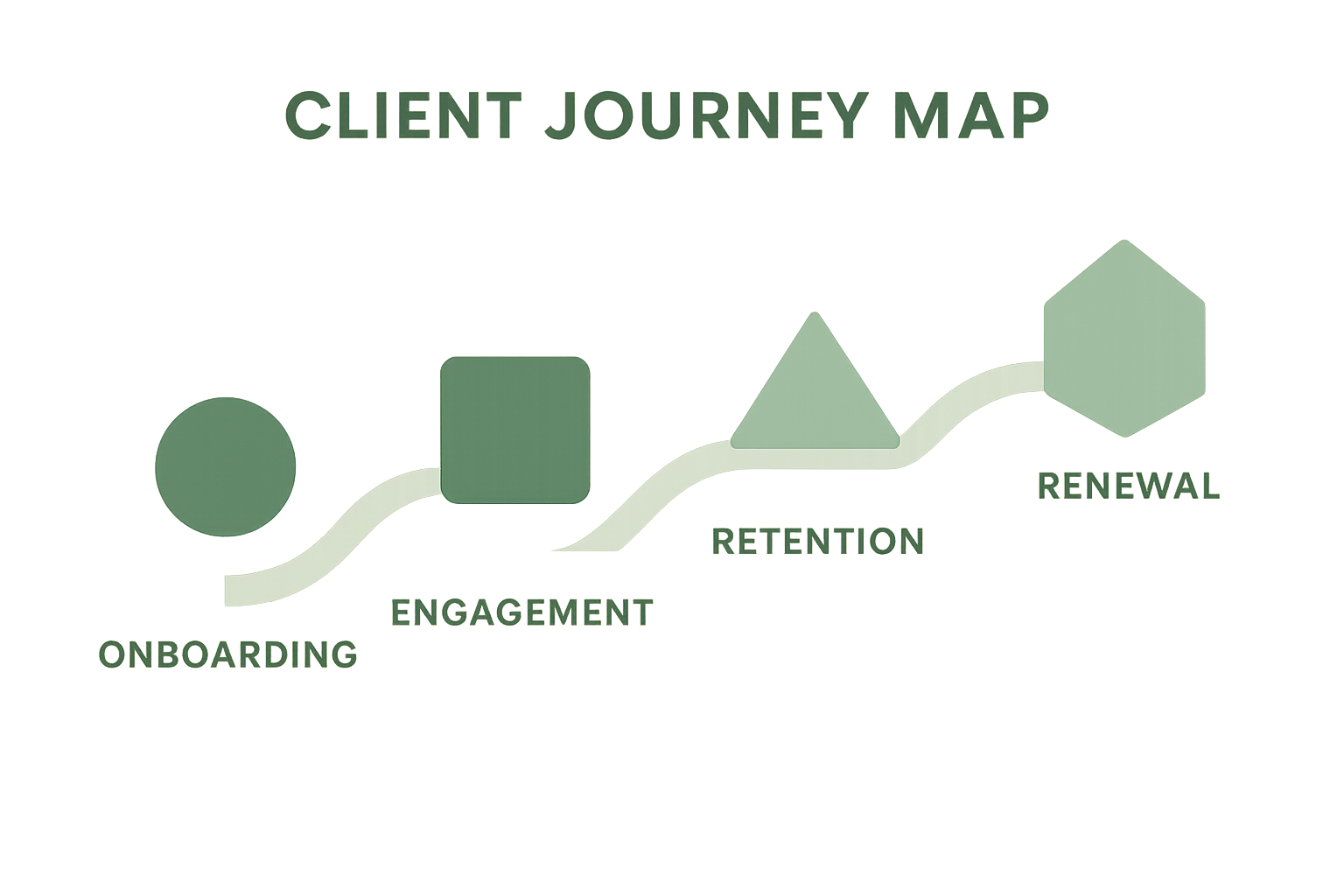
Mapping the client journey reveals exactly when to ask for advocacy.
Customer Advocacy vs. Referral Programs vs. Customer Success
A traditional referral program is a single tactic: ask a happy client for an introduction, sometimes with an incentive attached. A customer advocacy program, in contrast, is the broader system that makes those referrals possible in the first place. It includes reviews, testimonials, case studies, renewals, and expansion revenue, not just new-lead referrals.
Similarly, customer success focuses on helping a client achieve their desired outcome with your service — it is largely internal and operational. Advocacy, however, is the outward-facing result of that success being realized consistently. In short, customer success creates the conditions; a customer advocacy program captures the upside.
This distinction matters because a client who is not genuinely satisfied will rarely respond well to a referral ask, regardless of incentive. The concept of customer advocacy, as documented on Wikipedia, centers on acting in the client's interest first, which naturally produces referrals as a byproduct rather than the primary goal.
Customer Advocacy Program Examples and Advocacy Asks
Concrete examples make a program easier to launch than abstract principles alone. Consider rotating through these asks based on the client segment and health score:
- Post-renewal review request: ask for a G2, Google, or Clutch review within a week of a signed renewal, while the win is fresh.
- Milestone case study: after a client hits a quantifiable result, invite them to co-author a short case study.
- Warm referral introduction: ask a thriving client to introduce one peer who faces a similar challenge they once had.
- Advisory board seat: invite your top five to ten clients to a quarterly feedback session in exchange for early product or service access.
- Co-branded webinar or panel: feature a happy client as a speaker, giving them visibility while showcasing results to prospects.
Tools and Technology That Support Advocacy Program Success
Most effective programs combine three layers of technology: a CRM for contact and deal data, a survey or QBR process for direct feedback, and a relationship health system that consolidates signals from calls, billing, and project activity. Without the third layer, teams often rely on quarterly check-ins alone, which misses problems that develop between reviews.
A well-known measurement framework here is the Net Promoter Score, which asks clients how likely they are to recommend a business. While useful, NPS alone is a lagging indicator; it tells a team what already happened rather than what is about to happen. That is why many agencies pair survey data with continuous scoring, such as ClientBloom's Client Retention Score, which updates daily from CRM, billing, meeting, and call transcript data rather than waiting for a survey cycle.
For teams comparing options, this client retention software buyer's guide breaks down what to look for. Additionally, before investing in new tooling, it can help to estimate the potential upside first using ClientBloom's client retention ROI calculator.
Common Mistakes to Avoid When Launching a Client Advocacy Program
The most frequent mistake is asking for a referral or review before confirming the client is genuinely satisfied. This often backfires, since an unhappy client asked for advocacy may become more aware of their dissatisfaction. Instead, the health signal should come first and the ask second.
Another common error is ignoring onboarding. A weak first-30-days experience sets a negative tone that is difficult to reverse later, no matter how strong later service becomes. Teams that design a deliberate onboarding and milestone-tracking process, as outlined in this guide on reducing client churn, tend to see fewer early-stage cancellations.
Finally, many teams rely on gut feel instead of data, and fail to assign clear ownership of follow-up. Without a named owner for each health alert, warning signs get noticed but not acted on, which defeats the purpose of the program. In addition, over-asking the same handful of advocates burns goodwill quickly, so spreading asks across a wider pool matters just as much as timing each one well.
Measuring the ROI of Your Customer Advocacy Program
To know whether a customer advocacy program is working, track five metrics over time: retention rate, renewal rate, referral volume, expansion revenue, and average relationship health score. Comparing these figures before and after launch reveals whether behavior actually changed, rather than relying on anecdotes.
In addition, segmenting results by account type — for example, retainer clients versus project-based clients — often shows where the program delivers the most value first. Teams that want a deeper look at how AI-assisted monitoring affects these numbers can review this AI client experience platform guide for agencies, which covers how automated scoring ties back to renewal outcomes.

Tracking retention and referral trends shows whether an advocacy program is paying off.
Incentive Ideas That Keep Advocates Engaged
Incentives should match the effort requested. A quick review deserves a small thank-you, while a case study or referral that closes deserves something more meaningful.
- Account credit or discount: applied to the next invoice for a completed referral or case study.
- Public recognition: featuring the client's logo, quote, or leadership on your website or newsletter.
- Early access: giving advocates first access to new services, features, or pricing tiers.
- Co-marketing exposure: promoting the client's own business through your channels in return.
- Simple personal thanks: a handwritten note or direct message from leadership, which costs nothing but is often undervalued.
Service businesses evaluating options for automating this work can start with ClientBloom, which scores client relationship health daily and sends a morning brief explaining who to contact and why, built specifically for agencies and consultancies managing five or more active client accounts.
Frequently Asked Questions About Customer Advocacy Programs
What is a customer advocacy program?
A customer advocacy program is a structured effort that identifies happy clients and turns their satisfaction into referrals, reviews, case studies, and renewals. It relies on tracking relationship health and acting on advocacy moments as they happen.
How is a customer advocacy program different from a referral program?
A referral program is a single tactic focused on getting new leads, while a customer advocacy program is broader and includes reviews, testimonials, case studies, renewals, and expansion revenue. Referrals are one output of a healthy advocacy strategy, not the whole strategy.
How is a customer advocacy program different from a customer success program?
Customer success focuses on helping a client achieve their desired outcome, which is largely internal and operational. A customer advocacy program is the outward-facing system that captures the referrals, reviews, and case studies that result once success is achieved consistently.
Why do service businesses need a client advocacy strategy?
Service businesses depend on recurring revenue from retainers and renewals, so losing a client costs far more than losing a one-time sale. A client advocacy strategy protects that revenue by catching at-risk accounts early and turning satisfied ones into growth engines.
How much does it cost to run an advocacy program?
Costs vary based on team size and tooling, ranging from a few hours of staff time per week for a manual process to a monthly platform fee for automated health scoring and workflows. Most agencies start lean and expand the program as it proves ROI.
How long does it take to launch a customer advocacy program?
A basic version can launch in two to four weeks once client data and journey stages are mapped. Full integration with CRM, billing, and communication tools typically takes about one to six weeks depending on team readiness.
What tools support a customer advocacy program?
Most programs combine a CRM, a survey or QBR process, and a relationship health scoring system that pulls from calls, billing, and project data. Purpose-built platforms reduce manual tracking by consolidating these signals into one dashboard.
What are the main types of customer advocacy programs?
The five main types are referral advocacy, review and testimonial advocacy, case study and co-marketing advocacy, community and advisory board advocacy, and social or peer-to-peer advocacy. Most mature programs use a mix of all five.
What are common mistakes when building an advocacy program?
The most common mistake is asking for a referral or review without first confirming the client is genuinely happy. Other frequent errors include ignoring onboarding, relying on gut feel instead of data, over-asking the same advocates, and failing to assign clear ownership of follow-up actions.
How do you measure the success of a customer advocacy program?
Track retention rate, renewal rate, referral volume, expansion revenue, and a relationship health score over time. Comparing these metrics before and after launch shows whether the program is actually changing client behavior.
What incentives work best for customer advocates?
Incentives should scale with the effort requested, ranging from account credits and early access for quick reviews to co-marketing exposure or public recognition for case studies and referrals. Personal thanks from leadership also goes further than many teams expect.
Can small teams run a customer advocacy program without extra headcount?
Yes, many agencies run advocacy programs with existing account managers by automating health scoring and alerts instead of adding staff. Automation handles the monitoring so the team can focus on the actual client conversations.
What role does onboarding play in client advocacy?
A strong first-30-days onboarding experience sets the tone for the entire relationship and heavily influences whether a client later becomes an advocate. Clients who hit early milestones are far more likely to renew and refer.
How often should client health be reviewed in an advocacy program?
Health signals should be monitored continuously, with a formal review at least monthly and a structured quarterly business review for key accounts. Continuous monitoring catches problems weeks before a quarterly check-in would.
Does a customer advocacy program replace a CRM?
No, an advocacy program works alongside a CRM rather than replacing it. The program adds relationship scoring, triggers, and advocacy workflows on top of the contact and deal data a CRM already stores.
Who should own the customer advocacy program inside an agency?
Ownership typically sits with a client services or customer success lead who can coordinate between account managers, sales, and leadership. Clear ownership prevents advocacy opportunities from being noticed but never acted on.
Final Thoughts on Building a Lasting Advocacy Program
Ultimately, a customer advocacy program succeeds when it becomes part of daily operations rather than an occasional campaign. By auditing current relationships, mapping advocacy moments, identifying the right advocates, and tracking health signals continuously, service businesses can catch risk early and convert satisfaction into referrals, renewals, and expansion revenue. Above all, consistency matters more than any single tactic — a well-run customer advocacy program compounds in value the longer it runs, because every retained and referring client makes the next cycle of growth a little easier to achieve.


