
AI Client Experience Platform: A Guide for Agencies
An AI client experience platform is purpose-built software that watches every client relationship across your agency or consultancy, scores how healthy each one is in real time, and tells your team exactly who needs attention before a single renewal is ever at risk. Rather than waiting for a cancellation email, an AI client experience platform turns scattered signals — a slower reply, a skipped call, a quiet drop in engagement — into one clear, prioritized action list your team can act on every single morning.
Quick answer: An AI client experience platform connects to the CRM, billing, meeting, and project tools you already use, blends that data into a single daily health score per client, and pushes alerts about churn risk or expansion opportunity straight to your team — replacing quarterly reviews with a continuous, automated early-warning system.
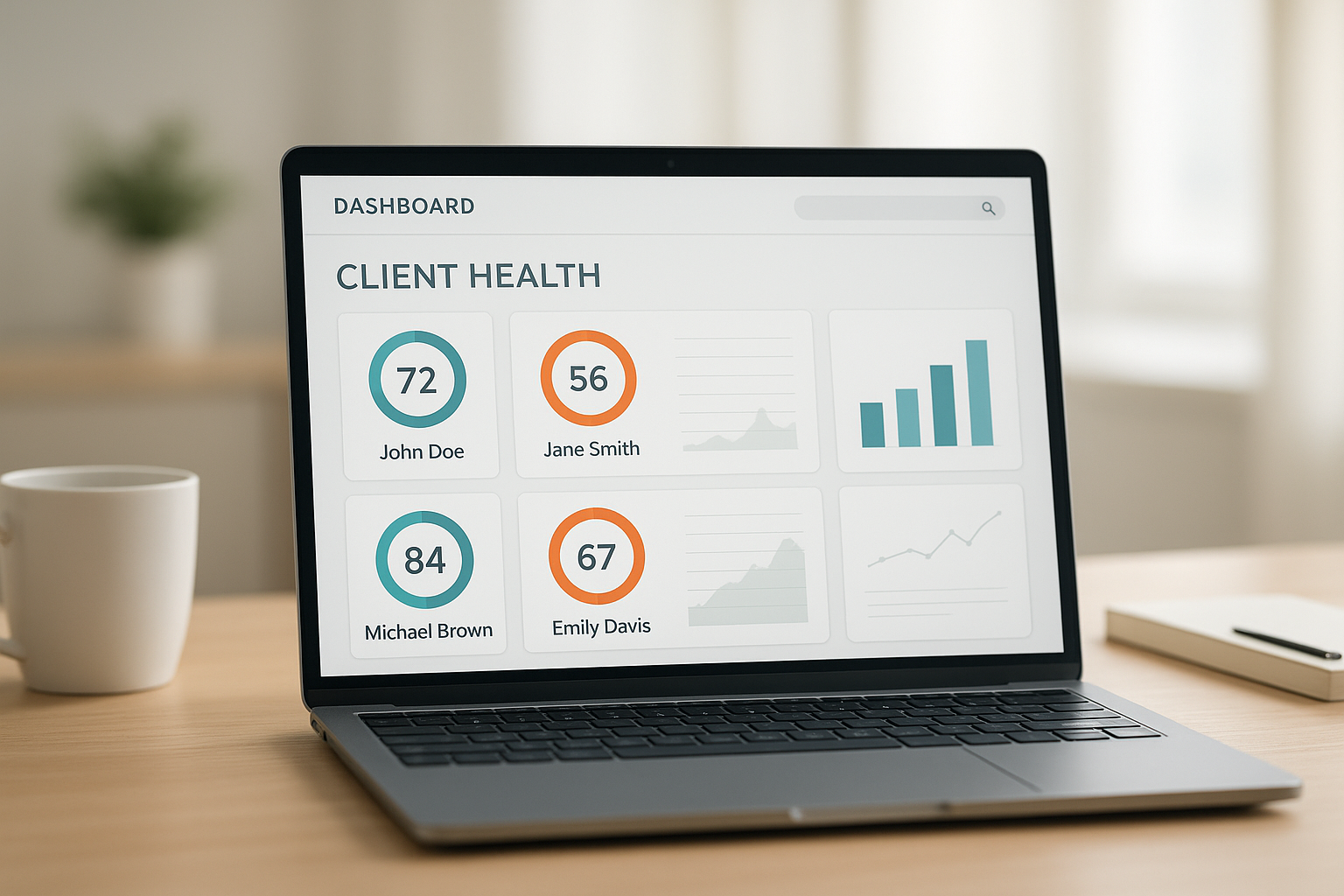
A typical view inside an AI client experience platform, where every account gets a daily health score.
What Is an AI Client Experience Platform?
An AI client experience platform is a layer of software that sits on top of the tools a service business already uses — CRM, billing, meeting notes, project management — and turns that scattered data into one clear signal: is this client relationship healthy or at risk? Instead of waiting for a cancellation email, the system flags declining engagement weeks in advance.
In practice, this looks like a continuous score, usually on a 0-to-10 scale, that updates as new data comes in. For example, ClientBloom's Client Retention Score blends communication frequency, sentiment, onboarding milestones, and billing patterns into a single number that a customer success manager can glance at each morning. Consequently, retention stops being a guessing game and becomes a measurable, repeatable process.
Above all, the term "AI client experience platform" describes a category, not a single feature. Some vendors emphasize client health scoring, others lean toward churn forecasting, and a few focus on client-facing hubs. The strongest systems combine all three so that internal teams and clients both benefit from the same underlying intelligence.
Client Experience Software vs. CRM vs. Client Portal: What's the Difference?
Many buyers confuse these three categories, which leads to disappointing purchases. In reality, each tool answers a different question, and understanding the split matters before you sign a contract.
CRM: Where client data lives
A CRM (customer relationship management system) stores contact records, deal history, and notes. It answers "who is this client and what have we agreed to?" However, a CRM rarely tells you whether a relationship is deteriorating, since that requires analyzing patterns across many data sources at once.
Client portal: Where clients interact
A client portal is the client-facing hub — shared documents, progress trackers, and messaging. It answers "what does the client see and experience day to day?" In contrast, a portal is largely a presentation layer; it does not analyze behavior or predict risk on its own.
AI client experience platform: Where risk gets caught early
An AI client experience platform answers a third, more urgent question: "which relationships need attention today, and why?" It reads data from the CRM, billing system, and communication tools, then applies scoring logic to surface risk and opportunity automatically. Many agencies ultimately run all three together — CRM for records, a portal for client-facing collaboration, and an AI client experience platform as the intelligence layer that watches both.
Why Service Businesses Need an AI-Powered Client Experience Solution
Service businesses that bill on retainer — marketing agencies, consultancies, coaching practices, and fractional executive firms — depend on renewals more than new logos. According to Harvard Business Review's research on customer economics, increasing retention by even a small margin can lift profits dramatically over time, since existing clients are far cheaper to keep than new ones are to acquire.[1]
However, most teams still manage retention manually, relying on a CSM's memory or a spreadsheet that gets updated once a month. As a result, early warning signs — a slower response time, a skipped check-in call — go unnoticed until a client is already halfway out the door. This is the gap an AI-powered client experience platform is built to close, by watching those signals continuously rather than periodically.
In addition, churn is rarely about satisfaction alone. A client can report being "satisfied" on a survey while quietly disengaging from meetings and deliverables. Churn rate research shows that behavioral signals often predict attrition more reliably than stated sentiment, which is exactly why platforms built on engagement data tend to outperform survey-only approaches.[2]
Core Capabilities of a Modern AI Client Experience Platform
Not every retention tool offers the same depth. Before evaluating vendors, it helps to know which capabilities actually move the needle for a service business managing dozens or hundreds of active accounts.
- Continuous relationship health scoring rather than static CSAT snapshots.
- Read-only integrations with CRM, billing, meetings, projects, and call transcripts.
- Daily briefs delivered where the team already works — Slack, email, text, or Telegram.
- Churn forecasting and renewal or expansion opportunity surfacing.
- Structured onboarding tracking across the client's first 30 days.
- Playbook design for churn intervention and at-risk escalation.
- Segment-level benchmarking so one account's score can be compared against similar clients.
- API or webhook support for routing alerts into custom internal workflows.
Specifically, the integration piece matters more than most buyers expect. A platform that requires replacing the CRM introduces migration risk and team resistance, whereas one that connects as a read-only layer — which is how ClientBloom is built — gets adopted faster because it does not disrupt existing workflows.

Teams review churn forecasts together once daily briefs surface which accounts need attention.
How an AI Client Experience Platform Works: Step-by-Step Implementation
Implementation generally follows a consistent sequence, whether a team handles it internally or works with a done-with-you installation partner. Here is the typical process:
- Audit current client data and tools. Review the CRM, billing system, meeting records, and project tools currently in use to understand what client data already exists and where gaps remain before any scoring model is built.
- Connect integrations and configure scoring. Link read-only connectors to the CRM, billing, and communication tools, then configure the platform's scoring model to reflect what healthy versus at-risk accounts look like for your business specifically.
- Design the retention playbook. Build escalation protocols and intervention plays that define exactly who gets contacted, by whom, and within what timeframe when a client's score declines below the agreed threshold.
- Train the team and launch daily briefs. Train customer success managers on the new workflow and turn on daily morning briefs so the team has a prioritized action list delivered automatically each day without manual review.
Notably, a guided setup can compress this entire process into about one week, which is how ClientBloom's installation is structured — audit, configuration, integrations, and training all handled together rather than spread across months. You can see the full walkthrough on the product tour.
Choosing the Right Client Experience Software for Your Business
When comparing vendors, start by asking whether the platform integrates with your CRM or expects you to replace it. According to Wikipedia's overview of customer experience management, the discipline is fundamentally about understanding interactions across every touchpoint, which means a platform that ignores your existing systems is working against the data you already have.[3]
Beyond integration, consider the fit for your business model. Marketing agencies on retainers, consulting firms, and coaching businesses tend to get the most value because they manage enough active client relationships for scoring to be statistically meaningful. For a closer look at how this applies by vertical, see how the approach is adapted for consulting firms and for coaching businesses.
Similarly, pay attention to whether onboarding is self-serve or guided. A done-with-you installation — covering audit, configuration, and CSM training — tends to produce faster, more consistent adoption than a free-trial tool teams are left to configure alone. You can explore the full feature set on the software overview page, or review a side-by-side breakdown of vendors on the detailed platform comparison before making a final decision.
AI Client Experience Platform ROI: Metrics That Prove the Investment
Leadership teams rightly want numbers before approving a new tool. Fortunately, an AI client experience platform produces metrics that are easy to track from the first month onward.
- Churn rate reduction: Compare quarterly cancellations before and after launch to quantify saved revenue directly.
- Net revenue retention (NRR): Track how much expansion revenue offsets or exceeds churn across the portfolio, a metric closely tied to customer retention economics.
- Early-warning lead time: Measure how many weeks in advance a declining score flags risk compared to when a client previously gave notice.
- CSM time saved: Track hours no longer spent manually compiling account status updates for leadership reviews.
- Onboarding completion rate: Monitor how many new clients hit key milestones within their first 30 days.
Consequently, teams that track these five metrics consistently can tie the platform's cost directly to retained revenue within the first two or three billing cycles, which makes renewal of the tool itself an easy decision.
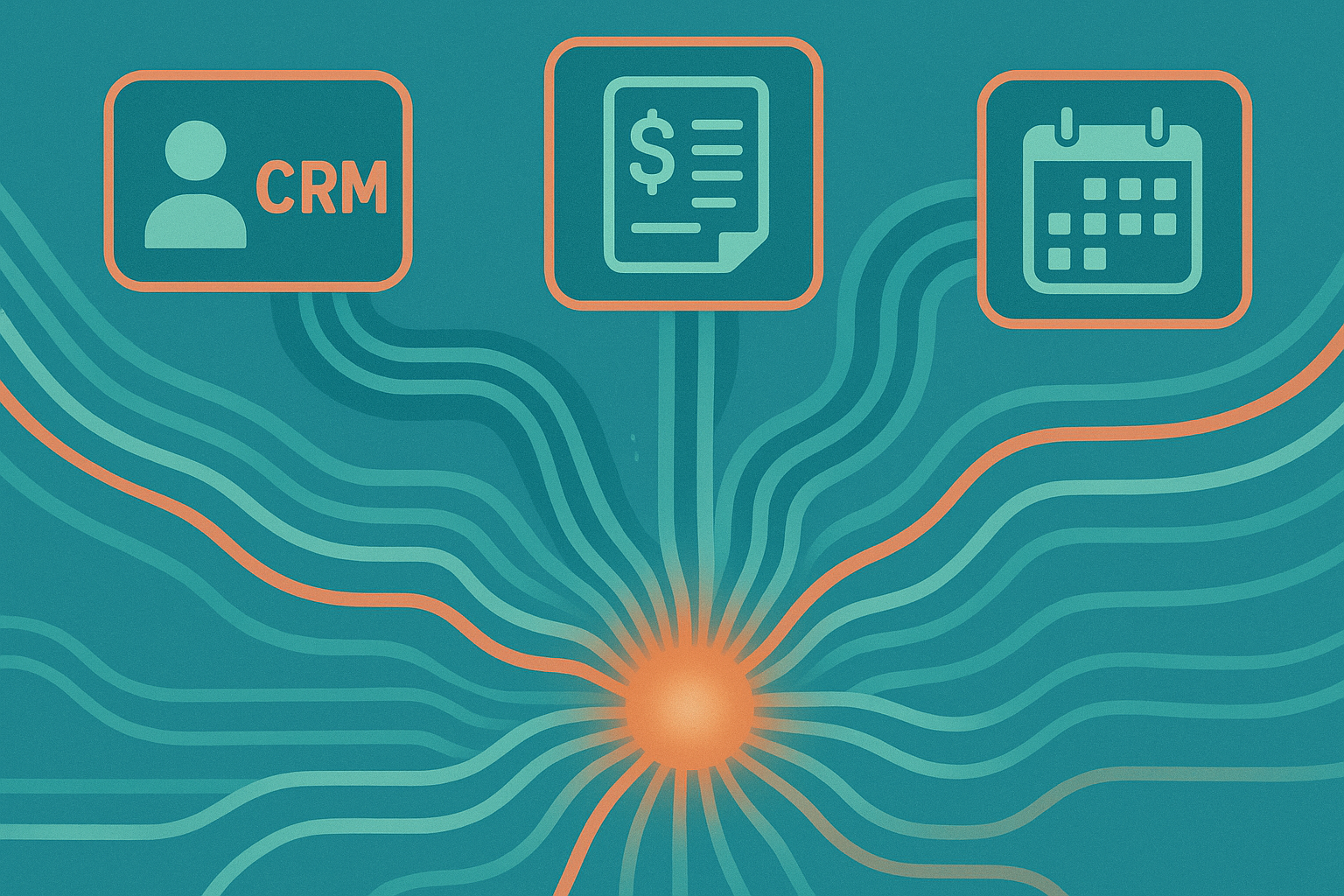
Read-only integrations pull data from existing tools without disrupting current workflows.
Common Mistakes When Adopting Client Experience Technology
Even strong tools fail when adoption is rushed. The most frequent mistake is buying a platform without redesigning the retention playbook around it, so alerts arrive but nobody owns the follow-up. Therefore, escalation protocols need a clear owner before launch, not after.
Another common error is skipping compensation and cadence design for customer success managers. If retention outcomes are not tied to how CSMs are measured or paid, daily briefs become background noise instead of action items. Finally, teams sometimes underinvest in the first 30 days of onboarding, which is often where churn risk is highest and hardest to reverse later.
In addition, dirty or incomplete CRM data quietly undermines scoring accuracy. Before launch, it is worth spending a few hours deduplicating contacts and closing stale deal records, since an AI client experience platform can only score what it can actually see.
Client Onboarding and the First 30 Days: Where Retention Is Won or Lost
Most churn decisions are made silently within the first month of a client relationship, long before a contract renewal date ever appears on the calendar. Specifically, a client who misses an onboarding milestone or never completes a kickoff call rarely recovers momentum on their own.
This is why an AI client experience platform tracks onboarding progress as its own scoring input, not as a separate checklist. For a deeper, step-by-step breakdown of building this process end to end, read the complete client onboarding automation guide, which pairs well with the retention workflows described here.
Frequently Asked Questions About AI Client Experience Platforms
What is an AI client experience platform?
An AI client experience platform is software that continuously monitors client relationships, scores their health, and alerts teams to risks or opportunities. It pulls data from existing tools like CRMs, billing, and meeting software to create a single view of each account.
How does an AI client experience platform differ from a CRM?
A CRM stores contact records and deal history, while a client experience platform analyzes that data to predict churn and surface action items. Most platforms, including ClientBloom, connect to your CRM rather than replace it.
How much does an AI client experience platform cost to implement?
Costs vary by vendor, team size, and the number of integrations required. Many platforms price based on active client count rather than per-seat, since the goal is portfolio-wide retention coverage.
How long does it take to set up an AI client experience platform?
A guided setup typically takes about one week, covering an audit, platform configuration, integrations, and team training. Self-serve tools can take longer because there is no structured onboarding.
What integrations does a client experience platform typically need?
Most deployments connect a CRM, billing system, meeting or call-transcript tool, and project management software. Read-only connectors let the platform observe activity without disrupting existing workflows.
Why do service businesses lose clients even when satisfaction scores are high?
Satisfaction surveys only capture a snapshot, while churn risk builds quietly through missed meetings, slow replies, or stalled projects. Continuous monitoring catches these signals before a client decides to leave.
What is a Client Retention Score and how is it calculated?
A Client Retention Score is a 0-to-10 rating of relationship health based on engagement, sentiment, delivery milestones, and billing patterns. It updates continuously rather than relying on quarterly reviews alone.
What common mistakes do agencies make when adopting retention technology?
The most common mistake is buying software without redesigning the retention playbook around it, so alerts get ignored. Teams also underinvest in training, which limits adoption during the first 30 days.
Can an AI client experience platform predict churn before it happens?
Yes, by tracking engagement trends and communication patterns over time, these platforms can flag declining accounts weeks before a cancellation notice. Early warning gives teams time to intervene.
What's the best way to train a team on a new client experience platform?
Pair platform training with updated operating cadences, such as morning briefs and escalation protocols, so the tool fits into daily work. Role-specific training for CSMs tends to drive faster adoption than generic onboarding.
Does an AI client experience platform replace customer success managers?
No, it supports them by surfacing which accounts need attention and why, so CSMs spend less time hunting for information. The platform handles monitoring; people still handle the relationship.
How do morning briefs improve client retention outcomes?
Morning briefs delivered to Slack, email, or text give teams a prioritized list of accounts to contact each day. This turns retention from a reactive scramble into a repeatable daily habit.
What size business benefits most from an AI client experience platform?
Established agencies, consultancies, and coaching businesses with a meaningful roster of active clients see the clearest return, since there is enough data to generate reliable health scores. Portfolios with only a handful of clients may not need automated scoring yet.
How do pulse checks and QBRs fit into a retention strategy?
Pulse checks are short, frequent surveys that catch sentiment shifts early, while quarterly business reviews provide a structured deeper assessment. Together they combine continuous monitoring with periodic human judgment.
What data privacy and security measures should an AI client experience platform have?
A reputable AI client experience platform should support role-based access controls, encrypted data in transit and at rest, and read-only integrations that never write back to your CRM. Look for vendors who document SOC 2 compliance or an equivalent third-party audit before connecting sensitive client data.
Can an AI client experience platform work alongside a white-labeled client portal?
Yes. An AI client experience platform typically operates behind the scenes to score relationship health, while a white-labeled client portal provides the client-facing hub for documents and updates. Many agencies run both together, using the platform's health scores to decide what surfaces inside the portal.
How is an AI client experience platform different from a client success platform built around onboarding templates?
A client success platform built around onboarding templates and shared success plans focuses on structuring the client-facing journey. In contrast, an AI client experience platform focuses on internal health scoring, churn prediction, and daily prioritization for the team managing that journey. The two approaches solve different halves of the same retention problem.
Key Takeaways
An AI client experience platform turns scattered client signals into a single daily number your team can act on, replacing guesswork with a repeatable process. In particular, the combination of continuous health scoring, read-only integrations, and daily briefs gives service businesses an early warning system they simply cannot build with spreadsheets alone.
Ultimately, the goal of any AI client experience platform is not just technology — it is keeping more of the revenue already won. For established agencies, consultancies, and coaching businesses ready to put this kind of system in place, platforms like ClientBloom pair the software with guided installation, so the retention operating system is running, trained, and in daily use within about a week.

