
The NRR formula is the calculation service businesses use to measure how much recurring revenue they retain and grow from existing clients over a given period, excluding any revenue brought in by new customers. For agencies, consultancies, and retainer-based firms, this single number often says more about the health of the business than new sales ever could. In other words, it answers the question every owner eventually asks: are we keeping the revenue we already won, or quietly leaking it out the back door?
Direct answer: NRR = (Starting Revenue + Expansion − Downgrades − Churn) ÷ Starting Revenue × 100. A result above 100% means expansion revenue outpaced losses; below 100% means the client base shrank even without counting new sales.
What Is the NRR Formula?
The NRR formula compares the recurring revenue a company had at the start of a period to the recurring revenue that same group of clients generates by the end of it. Specifically, it rewards upsells and expansion while penalizing downgrades and cancellations. Because new customer revenue is never included, NRR isolates how well a team actually manages and grows relationships it has already earned. For a deeper look at the related loss side of this equation, the guide to churn rate meaning and formula is a useful companion read.
Breaking Down the NRR Formula
The net revenue retention formula has four moving parts: starting revenue, expansion, downgrades, and churn. Starting revenue is simply the recurring revenue from existing clients at day one of the period, whether measured monthly or annually. Expansion revenue includes anything additional those same clients spend, such as added services, price increases, or upgraded retainers.
Downgrades, on the other hand, reflect clients who reduced their spend without leaving entirely. Churn captures clients who left completely. As a result, the formula nets out gains against losses within the exact same client cohort, which is why it's considered one of the most honest metrics in recurring-revenue businesses. According to Wikipedia's overview of customer retention, retaining existing customers is typically far less expensive than acquiring new ones, which is exactly why this formula matters so much to profitability.
How to Calculate Net Revenue Retention Step by Step
Calculating NRR is straightforward once the inputs are organized. Follow these four steps for any monthly, quarterly, or annual period:
- Gather starting revenue. Pull the total recurring revenue from all existing clients at the very beginning of the period, before any changes occur.
- Add expansion revenue. Include any upsells, cross-sells, or price increases that the same clients purchased during the period.
- Subtract downgrades and churn. Remove revenue lost to reduced contracts as well as revenue lost entirely from cancelled accounts.
- Divide and multiply by 100. Divide the adjusted figure by starting revenue, then multiply by 100 to get a clean percentage.
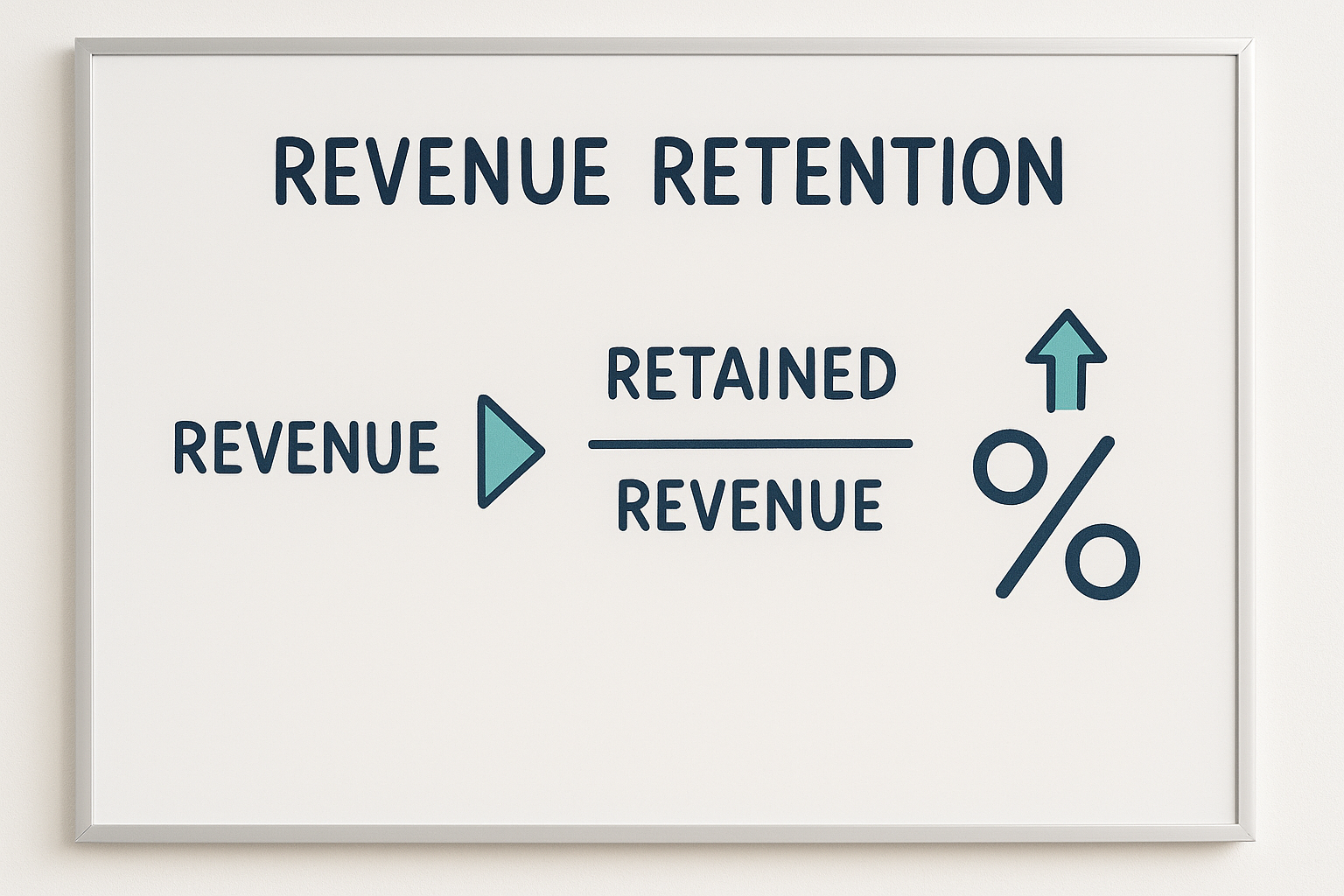
Breaking the NRR formula into four simple inputs makes the math easy to repeat every month.
NRR Formula Example in Practice
Consider a marketing agency that starts the quarter with $200,000 in recurring retainer revenue. During the quarter, existing clients add $25,000 in expansion work, while $10,000 is lost to a downgraded contract and $15,000 disappears from a cancelled client. Plugging those numbers into the NRR formula gives: ($200,000 + $25,000 − $10,000 − $15,000) ÷ $200,000 × 100 = 100%. In this case, expansion exactly offset the losses, so the agency's existing book of business held steady even though it lost one client entirely.
If expansion had reached $40,000 instead, NRR would climb to 107.5%, meaning the client base grew in value despite the churn. This is why NRR is considered a growth-and-risk metric at the same time. To see how churn alone would have scored this same scenario, the step-by-step churn calculation guide walks through a nearly identical example.
What Counts as a Good NRR Score?
Most benchmark reports consider 100% to 110% a solid, healthy NRR for established service businesses. For example, Bessemer Venture Partners' State of the Cloud report has repeatedly noted that top-performing recurring-revenue companies push NRR above 120%, while SaaS Capital's annual benchmark survey places the median closer to 100-105% across a broad range of company sizes. Anything consistently below 100% is a signal that churn and downgrades are outweighing expansion, which is often the first sign of a retention problem rather than a sales problem.

Tracking the NRR formula on a live dashboard turns a quarterly spreadsheet task into a daily habit.
Net Revenue Retention vs. Gross Revenue Retention
Gross revenue retention, or GRR, only accounts for downgrades and churn, which means it can never exceed 100%. Net revenue retention, by contrast, also credits expansion revenue, so it can climb well above 100% when upsells outpace losses. Comparing the two side by side is useful because a wide gap between them often reveals exactly where a retention strategy is working. If GRR is weak but NRR looks fine, expansion revenue from a handful of accounts may be masking a churn problem that will eventually catch up.
Similarly, tracking customer lifetime value alongside NRR paints a fuller financial picture. The CLV formula guide explains how to connect retention metrics to long-term client value, which is especially useful when building a business case for retention investment.
Common Mistakes When Using the NRR Formula
One frequent mistake is accidentally including new customer revenue in the calculation, which inflates the score and hides the true retention picture. Another is using inconsistent time windows, comparing a monthly figure against an annual one, which produces numbers that cannot be meaningfully trended over time. Teams also sometimes lump downgrades in with full churn, losing the ability to tell whether clients are leaving entirely or simply spending less.
Finally, many businesses calculate NRR only once a quarter from a spreadsheet, which means problems surface months after they started. For a closer look at how churn specifically gets miscounted, the customer churn rate calculation guide covers several of the same pitfalls in more depth.
How to Improve Your Net Revenue Retention Score
Improving NRR starts with visibility. Specifically, teams need a way to see which accounts are at risk before a renewal conversation, not after a cancellation notice arrives. Structured onboarding during the first 30 days, regular pulse checks, and proactive escalation protocols for at-risk accounts all move the needle because they catch problems while there is still time to fix them.
This is the exact gap ClientBloom was built to close. By connecting to the CRM, billing, and meeting tools a team already uses, ClientBloom scores every client relationship daily and sends a morning brief showing who needs attention and why. In addition, its analytics dashboard forecasts churn and surfaces renewal and expansion opportunities automatically, which means the inputs behind the NRR formula stay current without manual spreadsheet work. For businesses still estimating these numbers by hand, the free retention calculator is a fast way to see where things stand today.

Proactive reviews of at-risk accounts are one of the fastest ways to lift net revenue retention.
Frequently Asked Questions
What is the NRR formula?
The NRR formula is (Starting Revenue + Expansion Revenue − Downgrades − Churned Revenue) ÷ Starting Revenue × 100. It measures the percentage of recurring revenue a business retains and grows from its existing client base, excluding new customer revenue.
How do you calculate net revenue retention?
You calculate net revenue retention by taking starting recurring revenue, adding expansion revenue, subtracting downgrades and churn, then dividing by the starting revenue and multiplying by 100.
What is a good NRR percentage?
Most benchmark studies consider 100% to 110% a healthy NRR for service businesses, while top performers often exceed 120%. A score below 100% signals that churn and downgrades are outweighing expansion revenue.
Why does the NRR formula exclude new customer revenue?
The formula excludes new customer revenue so leaders can see how well the business retains and expands existing relationships on their own merits, without new sales masking the results.
What is the difference between NRR and GRR?
Gross revenue retention only accounts for downgrades and churn, so it caps at 100%. Net revenue retention also adds back expansion revenue, so it can rise above 100% when upsells outweigh losses.
How often should NRR be calculated?
Most service businesses calculate NRR monthly for internal tracking and quarterly for leadership or investor reporting. More frequent tracking helps teams catch at-risk accounts before renewal conversations happen.
What common mistakes do teams make with the NRR formula?
The most common mistakes are mixing in new customer revenue, using inconsistent time periods, and failing to separate downgrades from full churn. These errors inflate the score and hide real retention risk.
Does calculating NRR cost anything?
Calculating NRR manually from spreadsheets costs only staff time, though it becomes time-consuming as a client roster grows. Platforms that connect to billing and CRM data can automate the calculation with little added effort.
How long does it take to improve NRR?
Meaningful NRR improvement typically takes two to four renewal cycles, since the metric reflects decisions made months earlier. Early-warning retention scoring can shorten that timeline by flagging at-risk accounts sooner.
What causes low net revenue retention?
Low net revenue retention is usually caused by weak onboarding, inconsistent engagement, and missed upsell opportunities that let clients downgrade or churn. Identifying at-risk accounts earlier helps address these root causes before renewal.
Can the NRR formula be used outside of SaaS companies?
Yes, the NRR formula applies to any business with recurring revenue, including marketing agencies, consultancies, and retainer-based professional services. The same expansion-minus-churn logic works regardless of industry.
What is the best way to track NRR automatically?
The best way to track NRR automatically is to connect billing, CRM, and meeting data to a retention platform that recalculates the score continuously. This removes manual spreadsheet work and surfaces risk in near real time.
Key Takeaways
In summary, the NRR formula is one of the clearest signals a service business has for judging the health of its existing client relationships. Because it nets expansion revenue against downgrades and churn, it tells a more honest story than new sales figures ever could. As benchmarks from SaaS Capital and Bessemer show, scores above 100% reflect a business that grows from within, while anything lower deserves closer attention. Ultimately, tracking the NRR formula consistently, and acting on what it reveals, is one of the most reliable ways to keep more of the revenue a business has already earned.


