
Customer Health Score: A Complete Guide for Agencies
A customer health score is the single number that tells a service business whether a client is about to renew, expand, or quietly walk away. Usually expressed on a 0-to-10 scale or as red, yellow, and green, this score turns scattered signals — missed meetings, late invoices, cooling email threads, flat usage — into one clear reading the whole team can act on. Instead of discovering a problem when a cancellation email lands, agencies, consultancies, and coaching businesses that track this number consistently can see trouble forming weeks before it becomes irreversible. This guide goes further than most explainers on the topic: it covers what feeds the score, how to calculate it, which scoring model fits your business, and — most importantly — exactly how to put that score to work every single day.
Quick answer: A customer health score is a composite rating built from usage, financial, and sentiment data that predicts a client's likelihood of staying, growing, or leaving. Teams use it to flag at-risk accounts early and trigger a specific retention action rather than discovering risk after a cancellation.
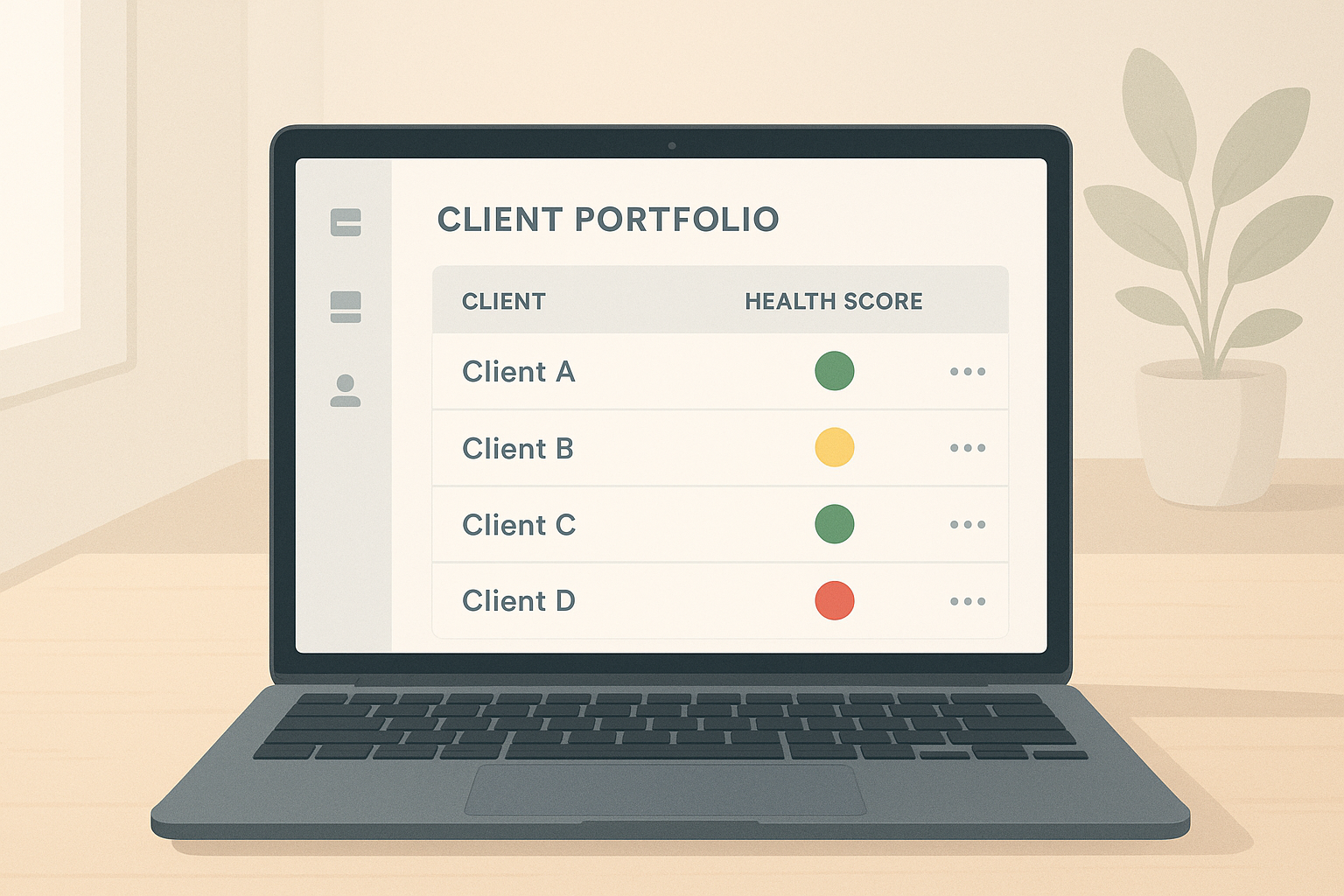
A customer health score dashboard turns scattered client signals into one trackable number.
What Is a Customer Health Score?
A customer health score is a composite metric that blends usage data, engagement signals, financial health, and sentiment into one rating that predicts whether a client will stay, grow, or leave. Think of it as similar to a credit score, except instead of predicting loan repayment, it predicts relationship stability. According to Wikipedia's overview of customer retention, keeping existing customers is consistently cheaper than acquiring new ones, which is exactly why a reliable early-warning score matters so much to agencies and consultancies running on retainers.
In practice, most platforms score accounts daily or weekly rather than once a quarter. As a result, a client who suddenly stops opening emails or delays an invoice shows up as a dip almost immediately, instead of surfacing three months later during a renewal conversation that is already too late to save.
Specifically, the term covers more ground than a simple satisfaction survey. A survey captures one moment in time. A customer health score, in contrast, continuously blends many data points — which is precisely why it catches risk that a single quarterly check-in would miss entirely.
Why a Client Health Score Drives Recurring Revenue
Recurring revenue businesses live and die by retention, not just new sales. Research popularized through Harvard Business Review has shown that increasing customer retention rates by as little as 5% can increase profits by 25% to 95%, depending on the industry. That gap exists because retained clients cost far less to serve than new ones acquired through sales and marketing.
A client health score makes that retention math actionable. Rather than hoping account managers notice warning signs on their own, the score forces a consistent, measurable view across every client in the portfolio. In addition, because the score is comparable across accounts, leadership can forecast churn risk at the portfolio level instead of relying on anecdotal updates from individual team members.
Furthermore, a shared score removes the guesswork from internal debates. When a client manager says an account "feels fine," a declining score gives leadership a concrete reason to dig deeper before the relationship quietly erodes.
Signals That Shape an Account Health Score
An account health score is only as good as the signals feeding it. Most effective models pull from a mix of behavioral, financial, and qualitative data rather than relying on a single input.
- Engagement frequency: meeting attendance, email replies, and response times.
- Payment behavior: invoice timeliness and billing disputes.
- Sentiment: survey scores, call transcript tone, and support ticket language.
- Usage depth: how fully the client is adopting the scope of work or deliverables.
- Champion stability: whether the primary contact has changed roles or left the company.
- Escalation history: frequency and severity of past issues raised.
- Outcome realization: whether the client has actually hit the results they hired you to deliver, not just whether they are attending calls.
Notably, that last signal — outcome realization — is the one most spreadsheet-based scores miss entirely. A client can attend every meeting and still churn if the engagement never produced the result they were promised.

Weighting inputs correctly is what separates a useful health score from a vanity metric.
Health Score Models: Which Approach Fits Your Business?
Not every customer health score should be built the same way. Choosing the wrong model is one of the quietest reasons a scoring program stalls, so it is worth understanding the three common approaches before you build anything.
Single-Score Models
A single-score model combines every input into one overall number. It is simple to explain and easy to put on a dashboard. However, it can hide problems — a client might score a healthy 7 overall while their billing relationship is quietly deteriorating underneath a strong usage number.
Multi-Dimensional Models
A multi-dimensional model scores each category separately — engagement, financial, sentiment, outcomes — and displays them side by side rather than collapsing them into one figure. As a result, a team can see exactly which dimension is driving risk instead of guessing. This approach takes more setup work but gives account managers far more specific, actionable context.
Predictive Models
Predictive models use historical churn data to weight each signal automatically, rather than relying on a team's best guess about what matters. These models improve over time as more churn and renewal outcomes feed back into the system. For agencies just starting out, a manually weighted multi-dimensional model is usually the better first step — predictive weighting works best once you have enough historical churn data to train it.
How to Build a Customer Health Score in 7 Steps
Building a reliable customer health score does not require a data science team. Instead, it requires discipline about what you track and, more importantly, what you do once a score drops.
- Audit your data sources. List every system that holds client signals, including the CRM, billing platform, meeting tools, project management software, and support desk, then identify which ones can connect through read-only integrations.
- Choose and weight your inputs. Select five to eight signals, such as engagement frequency, payment timeliness, meeting attendance, and sentiment, then assign each one a weight based on how strongly it has historically predicted churn.
- Set scoring thresholds. Translate the weighted total into a simple scale, such as 0 to 10 or red, yellow, green, and define exactly what range counts as healthy, watch-list, or at risk.
- Segment by client type. A brand-new client and a three-year account should not be judged by the same baseline, since a quiet new client is a far bigger red flag than a quiet long-term one. Build separate thresholds for onboarding, established, and renewal-window accounts.
- Assign ownership and escalation paths. Decide who gets notified when a score drops into the at-risk range, what the first response should be, and how far it escalates if nothing changes.
- Automate monitoring and alerts. Connect the model to a recurring refresh cycle and route alerts to channels the team already checks, so nobody has to remember to open a dashboard.
- Review and recalibrate quarterly. Compare scored predictions against actual churn and renewal outcomes every quarter, then adjust your weights accordingly. A score that is never recalibrated slowly drifts out of sync with reality.
For a deeper breakdown of how this connects to a broader retention strategy, the guide on what a client retention score actually measures walks through the relationship between scoring and day-to-day account management.
Putting Your Customer Health Score to Work
Calculating a customer health score is the easy part. The harder — and far more valuable — work is building the operating rhythm that turns a number on a screen into daily retention behavior. This is where most scoring programs quietly fail: the score exists, but nobody's workflow actually changes because of it.
Build Playbooks Around Score Triggers
Every threshold should map to a specific playbook, not a vague instruction to "check in." For example, a score that drops from green to yellow might trigger a check-in email within 48 hours, while a drop into red should trigger a direct call from a senior team member within the same day. Specificity is what separates a score that drives action from one that just sits in a report.
Bring the Score Into Renewal Conversations and QBRs
A customer health score should never be a surprise during a renewal conversation or a quarterly business review. Instead, the trend line leading up to that meeting should already have shaped the agenda — if a score has been sliding for two months, the QBR needs to open with a direct, honest conversation about what changed, not a generic recap of deliverables.
Align Account, Sales, and Delivery Teams Around One Score
In many agencies, account managers, sales, and delivery teams each hold a different, informal opinion of how a client is doing. A shared customer health score eliminates that disconnect. Consequently, when sales proposes an upsell, they can check the same score delivery is using, rather than pitching expansion to a client who is quietly at risk.
Report Trends to Leadership, Not Just Snapshots
Above all, leadership needs to see where the portfolio is heading, not just where it stands today. A monthly rollup that shows how many accounts moved from green to yellow, and why, gives executives a forward-looking view of revenue risk — something a single point-in-time score can never provide on its own.

A score only drives retention when the team reviews it on a consistent cadence.
Customer Health Score vs. Client Retention Score: What's the Difference?
These two terms often get used interchangeably, but there is a subtle difference. A customer health score is typically a snapshot, a single rating of current risk. A client retention score, by contrast, usually incorporates trend direction over time, tracking whether an account is improving, stable, or declining across weeks or months.
In practice, the most useful systems combine both views. Specifically, the current number tells you where an account stands today, while the trend line tells you whether yesterday's intervention is actually working. Teams that only look at the snapshot often miss slow-building risk that a trend would have caught weeks earlier.
Common Mistakes That Undermine a Customer Health Score
Even well-intentioned scoring systems fail for predictable reasons. Above all, the most damaging mistake is building a score nobody acts on.
- Using too many inputs without weighting the ones that actually predict churn.
- Relying on stale, manually updated spreadsheets instead of live integrations.
- Scoring usage alone while ignoring sentiment and financial signals.
- Failing to assign a clear owner for every at-risk alert.
- Treating the score as a reporting exercise rather than a trigger for action.
- Using the same thresholds for brand-new clients and long-tenured ones.
- Never recalibrating the model after the first few months of use.
According to the U.S. Small Business Administration, consistent customer service tracking is one of the clearest predictors of long-term business sustainability, which reinforces why the score needs to translate into actual outreach, not just a colored chart.
Best Practices for Turning Health Scores Into Retention Wins
A score is only valuable if it changes behavior. Therefore, the strongest retention programs pair the score with a clear operating cadence: daily briefs that flag at-risk accounts, a defined escalation protocol, and CSM training that tells the team exactly what to do when a score drops. Heads of accounts, in particular, benefit from a portfolio-level view rather than account-by-account checking, which is covered in more detail in the resources built for heads of accounts.
Similarly, frontline client success managers need the score delivered where they already work, whether that is Slack, email, or a morning text, rather than buried in a dashboard they have to remember to check. The guidance built for client success managers covers how to turn a daily score into a concrete call list.
In addition, it helps to understand exactly how the underlying mechanics work before rolling a score out company-wide. The how it works walkthrough breaks down the integration and scoring process step by step.
Who Should Use a Customer Health Score?
Customer health scoring works best for established service businesses with recurring revenue at stake, including marketing agencies on retainers, consultancies, fractional executives, and coaching or expert businesses managing multiple active clients at once. Coaching and expert-led businesses in particular often underestimate how much churn risk hides in quiet, disengaged clients, a pattern explored further in the resources for coaching businesses.
Businesses built around this exact problem, such as ClientBloom, connect directly to the CRM, billing, and meeting tools a team already uses, score every client relationship continuously, and deliver a morning brief naming exactly who to call and why. For a closer look at how that works end to end, the product tour walks through the full experience from integration to daily brief.
See Your Own Customer Health Score
Reading about a customer health score is useful; seeing one calculated for your own client base is far more convincing. Consequently, if you want a quick directional read on where your portfolio stands today, the free customer health score calculator walks through the same weighted-input logic described above using your own numbers, no integration required to get a starting estimate.
Frequently Asked Questions About Customer Health Score
What is a customer health score?
A customer health score is a single number, usually 0 to 10 or expressed as red, yellow, green, that combines engagement, financial, and sentiment data to predict whether a client will renew, grow, or churn. Service businesses use it to spot trouble early instead of finding out after a client has already decided to leave.
How is a customer health score calculated?
Most teams calculate it by weighting several inputs, such as engagement frequency, payment timeliness, support ticket volume, and survey sentiment, then combining them into one weighted total. The exact formula varies by business, but the goal is always the same: turn scattered signals into one actionable number.
Why does a customer health score matter for agencies and consultancies?
Agencies and consultancies rely on recurring retainers, so losing even a few accounts can wipe out months of new business effort. A customer health score gives account teams a warning system that flags at-risk clients weeks before a cancellation notice would otherwise arrive.
What is the difference between a customer health score and an NPS score?
An NPS score measures one thing, a client's likelihood to recommend you, captured at a single point in time through a survey. A customer health score is broader and continuous, blending NPS alongside usage, billing, and engagement data into a daily or weekly rating.
How much does it cost to build a customer health score system?
Costs range from free spreadsheet models for a handful of accounts to monthly platform subscriptions for businesses managing dozens of clients across multiple tools. The right investment depends on portfolio size, since manual scoring becomes unreliable once a team manages more than a few clients at once.
How long does it take to set up a customer health score?
A basic spreadsheet version can be running within a few days, while a fully integrated, automated version connected to a CRM, billing, and meeting tools typically takes one to two weeks to configure and validate. Setup time mostly depends on how many data sources need to be connected.
What are the most common mistakes when building a customer health score?
The most common mistakes are using too many inputs without weighting them, relying on stale or manually updated data, and failing to tie a low score to a specific action. A score that nobody acts on is simply a dashboard, not a retention tool.
What data sources feed a customer health score?
Typical data sources include the CRM, billing and invoicing systems, meeting and call transcripts, project management tools, and survey platforms. Connecting these sources through read-only integrations lets the score update automatically instead of relying on manual entry.
How often should a customer health score update?
A customer health score should update daily or at minimum weekly, since account conditions can shift quickly after a missed meeting, a late payment, or a key contact leaving. Monthly updates are too slow to catch most early warning signs.
Can small service businesses use a customer health score?
Customer health scoring works best for established service businesses managing at least five active client relationships, since that is the point where manual tracking in someone's head starts to break down. Agencies, consultancies, and coaching businesses with growing client rosters typically see the fastest return.
What is a good threshold for flagging an at-risk client?
Many teams set the at-risk threshold at scores below 5 on a 0-10 scale, or anything marked red on a traffic-light system, and trigger an escalation protocol automatically. The right threshold should be tested against actual churn history rather than picked arbitrarily.
Does a customer health score replace a CRM?
No, a customer health score does not replace a CRM; it reads data from the CRM and other tools to produce a combined rating. The CRM remains the system of record while the health score becomes the layer that interprets what that data actually means for retention.
How does a customer health score help with renewals and expansion?
A rising customer health score often signals a client who is ready for an upsell or expanded scope, while a falling score flags a renewal conversation that needs extra attention. Tracking the trend over time, not just the current number, gives account teams a head start on both opportunities.
What is a good customer health score benchmark to aim for?
There is no universal benchmark, since healthy thresholds vary by industry and client tenure. That said, most teams aim to keep at least 80% of their portfolio in the green zone, with no more than 10% sitting in red at any given time. Benchmarks should ultimately be calibrated against your own historical churn data, not an industry average.
How do you present a customer health score to executives and clients?
Internally, leadership generally wants trend reporting — how many accounts moved between tiers and why — rather than a single snapshot number. Externally, most agencies do not share the raw score with clients at all; instead, they use the underlying insight to shape a more informed, proactive conversation during check-ins and renewals.
What's the difference between a customer health score and a QBR?
A quarterly business review, or QBR, is a periodic meeting used to review outcomes with a client, while a customer health score is a continuous, automated rating updated far more often. In the strongest retention programs, the score's trend line directly shapes what gets discussed in the next QBR, rather than the two running as separate, disconnected processes.
Final Takeaway
A customer health score turns the guesswork out of retention. Instead of relying on a single account manager's instincts, the score combines engagement, financial, and sentiment data into one consistent, trackable number that the whole team can rally around. As this guide has shown, the real value comes not from the score itself, but from choosing the right model, pairing it with weighted inputs and clear thresholds, and — above all — building the playbooks, QBR habits, and escalation paths that turn a number into action. For service businesses that depend on recurring revenue, treating the customer health score as a daily operating habit, rather than a quarterly report, is what ultimately keeps more of the revenue already won.


